Activity 4: Brussels and its economic structures

Brussels, the city of traffic jams?
Activity 4: Brussels and its economic structures
As you have seen, the Brussels-Capital Region nowadays generates almost 20% of Belgium's GDP. If we add the outer parts of the metropolitan area, this figure rises to 31%. It is thus certainly the economic engine of the country. By comparison, the weight of the other metropolitan areas in the national GDP is much less, with 11% for Antwerp, 6% for Ghent, 5% for Liège and 3% for Charleroi.
The structural organisation of Brussels' economy is very specific compared with the national economy as a whole and the four foregoing metropolitan areas in particular. Since the end of the 1960s, the capital has experienced a faster rate of deindustrialisation than these areas. As previously seen, Brussels was the country's leading industrial city at the end of the 19th century and had a very diversified industry in the 1930s to 1960s. These days, traditional urban industries such as clothing, food, tobacco and metalworking have largely disappeared. What remains of the industrial sector are mainly small enterprises that supply directly to retailers or provide services to the population. Brussels has also retained the headquarters of a few companies in the manufacturing sector. For all these reasons, 54% of jobs in the "manufacturing sector" of the Brussels-Capital Region are currently held by workers with “employee contracts” (rather than “manual labour” contracts), compared with the national average of 36%.
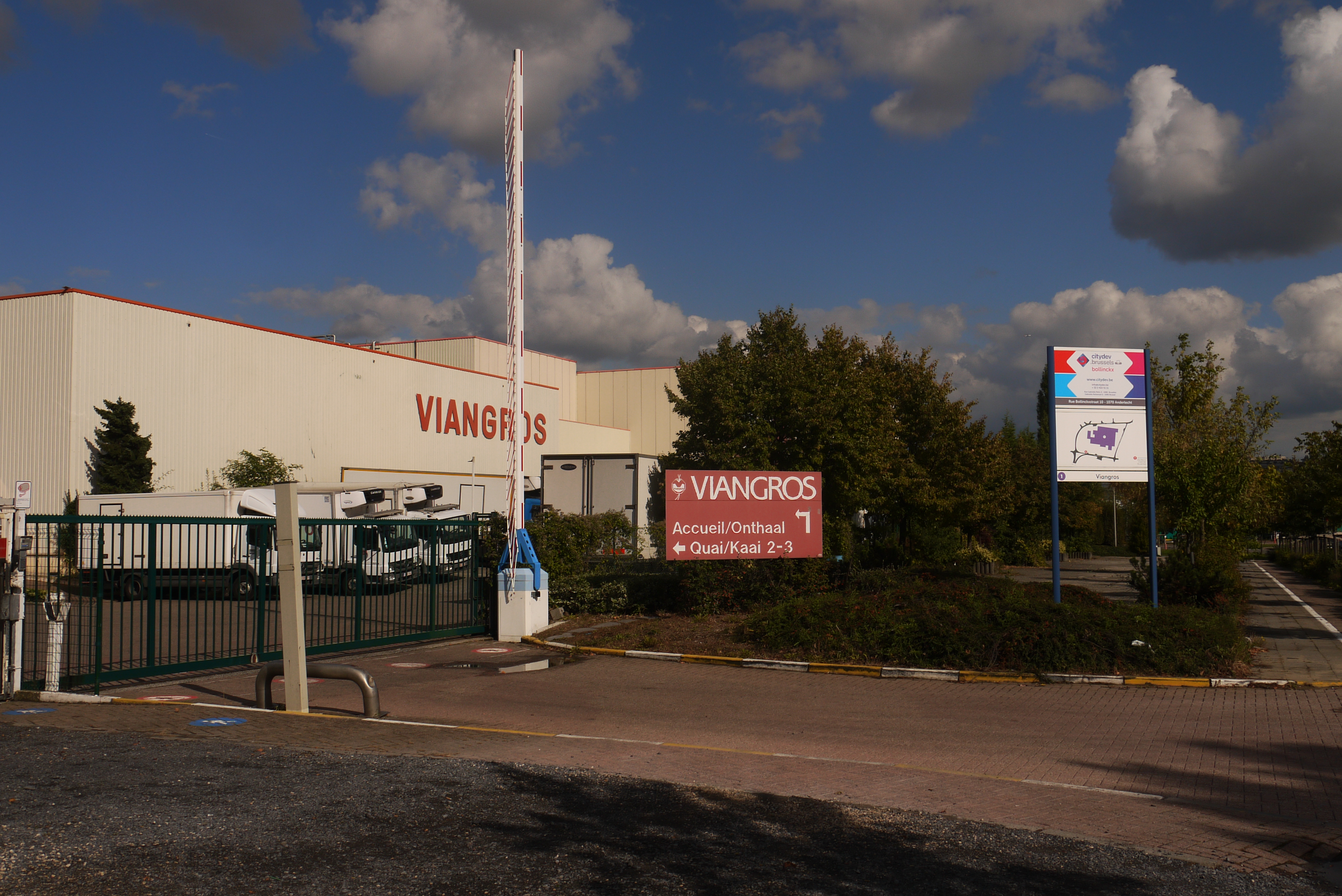
The headquarters of Viangros, a company specialising in the processing and distribution of fresh meat and catering products, in Anderlecht. © Mathieu Strale, 2014.
At the beginning of the 20th century, several of Brussels' central districts - as well as the vicinities of railway stations and the canals of Willebroek and Charleroi - were dotted with industries. The factories were often embedded in a very dense urban fabric. Nowadays, the "industrial" landscapes that we see along the canal mostly consist of logistics companies, warehouses or distribution centres for building materials. The manufacturing sector contributes very little to employment in the Brussels-Capital Region these days (only 3.3% of salaried staff). Ironically, it also makes up only a tiny proportion of blue-collar employment, which is nowadays mainly concentrated in services (83.3%) and is even more prominent in construction (8.8%) than in industry (7.7%).
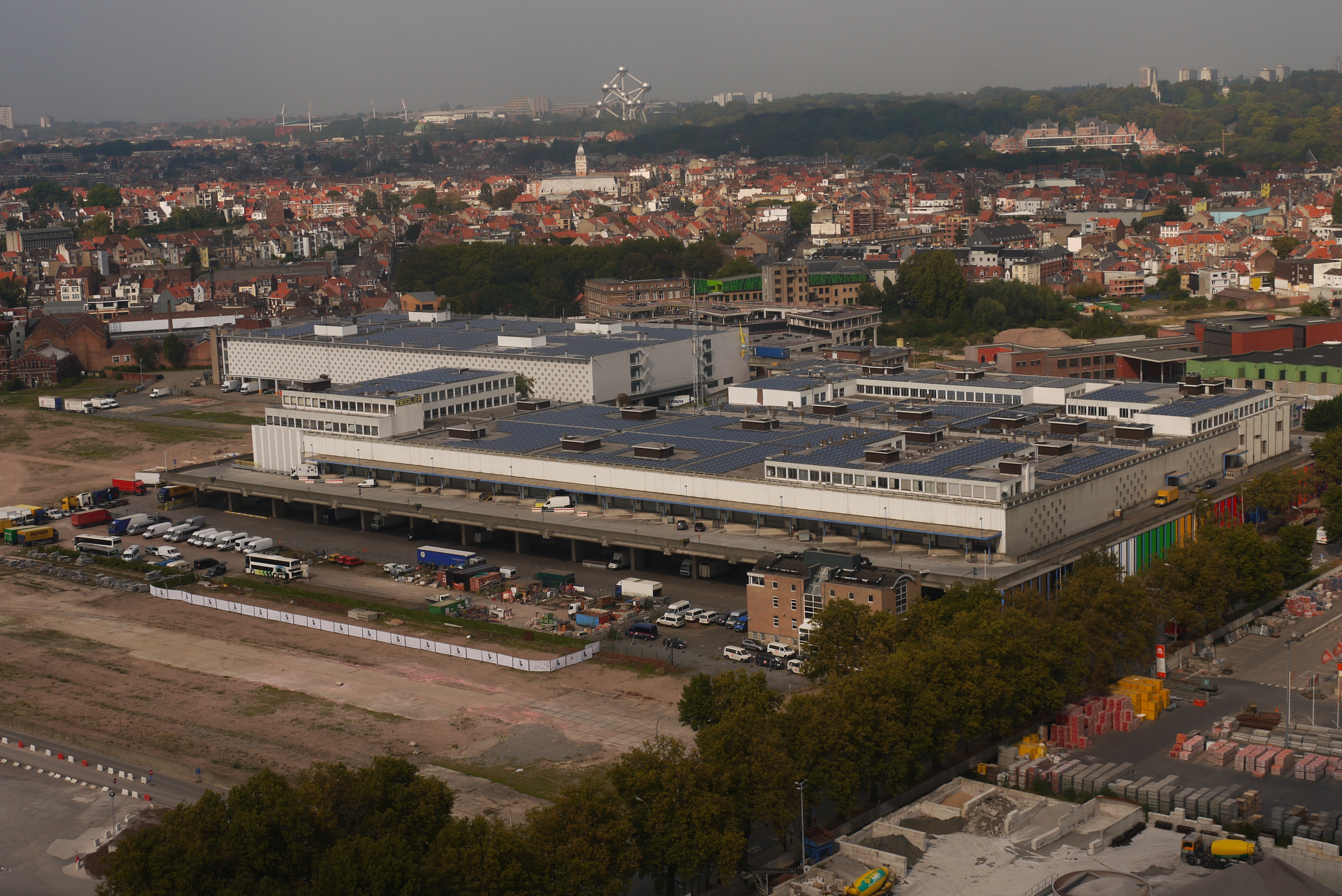
The International Road Transports (TIR - Transport International Routier) Logistics Centre located in the Port of Brussels, Laeken
© Mathieu Strale, 2014.
Since Belgium's independence, the economy of Brussels has certainly benefited from its function as the national capital. Not only due to the political and administrative activities this entails, but also because of the presence of the headquarters of financial holding companies that control most of the Belgian economy. Over the past half-century, however, it is the presence of the European institutions that has been one of the driving forces of the capital's economic development. Brussels has established itself as a major city for the organisation of congresses and is home to the largest number of embassies in the world (even more than Washington), with many countries establishing diplomatic offices there. This includes representations to Belgium, of course, but also to the European Union and sometimes even to NATO.
As visible on the map below, the numerous diplomatic establishments clearly favour neighbourhoods close to the centres of power and international institutions, for example around the Royal Park or the European quarter. As locations of prestige, many embassies are also situated in the residential areas of the south-east, where Brussels' elites traditionally live. The largest concentration of embassies can be found along prestigious boulevards such as Avenue Louise / Louizalaan, Avenue Franklin Rooseveltlaan, and Avenue de Tervuerenlaan.
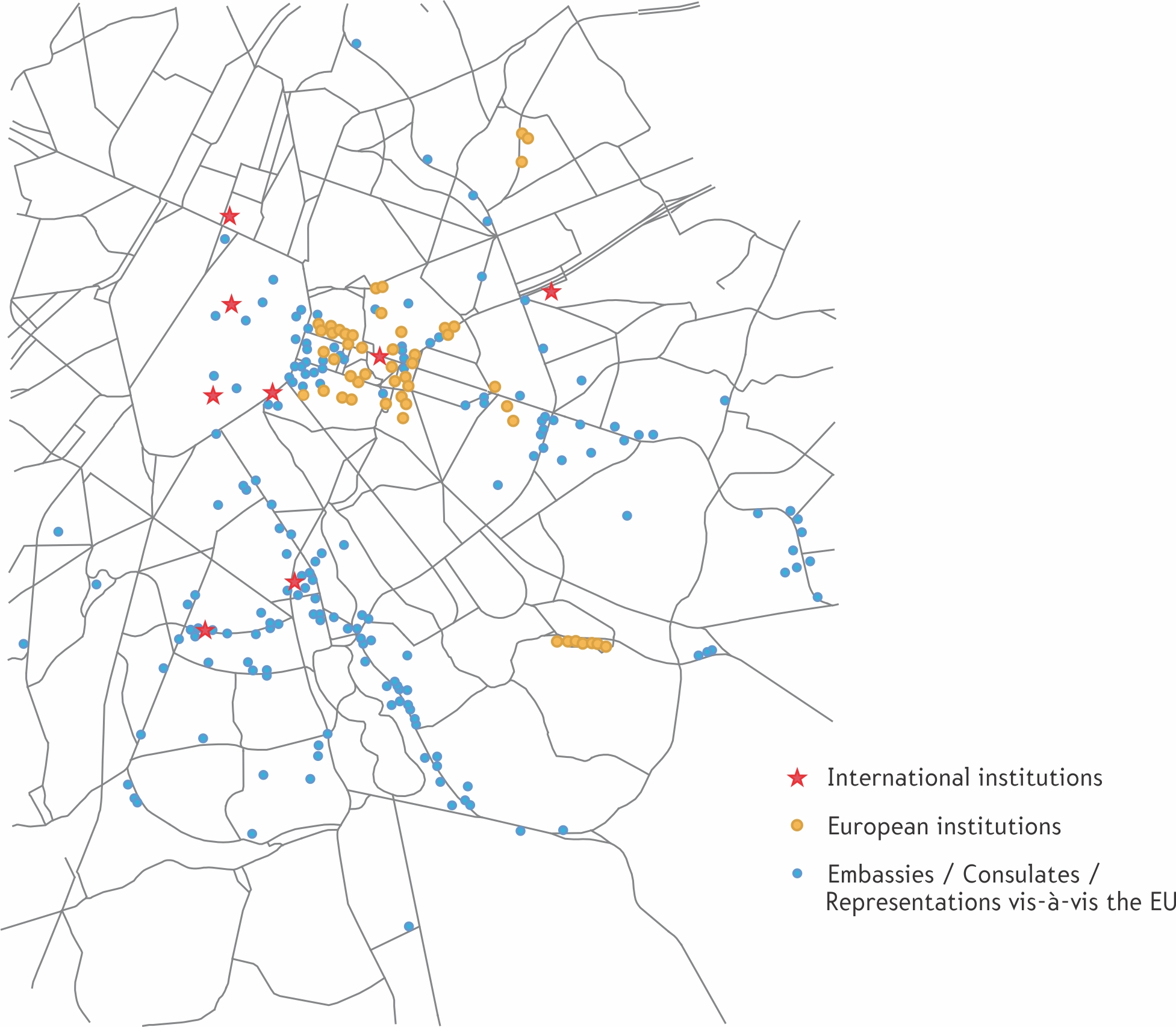
The presence of international and European institutions in Brussels. Source: VANDERMOTTEN C., Bruxelles, une lecture de la ville : de l’Europe des marchands à la capitale de l’Europe. Brussels, Éditions de l’Université de Bruxelles, 2014.
International functions account (directly and indirectly) for 13 to 14% of the Brussels-Capital Region's GDP, along with a similar proportion of the Region's 700,000 jobs. The local presence of the European Union accounts for the establishment of regional offices or headquarters of multinational firms in Brussels, as well as the weight of financial services in the capital's economy. As such, Brussels is the main gateway for the Belgian economy into international networks, in addition to its role as the control centre of the Belgian economy. All of this explains the significant share of administrative and decision-making activities in the Region's territory.
The following graph shows the relative weight of the different sectors of activity in the Brussels economy. It also reveals the specific characteristics of Brussels in relation to Belgium's other urban areas.
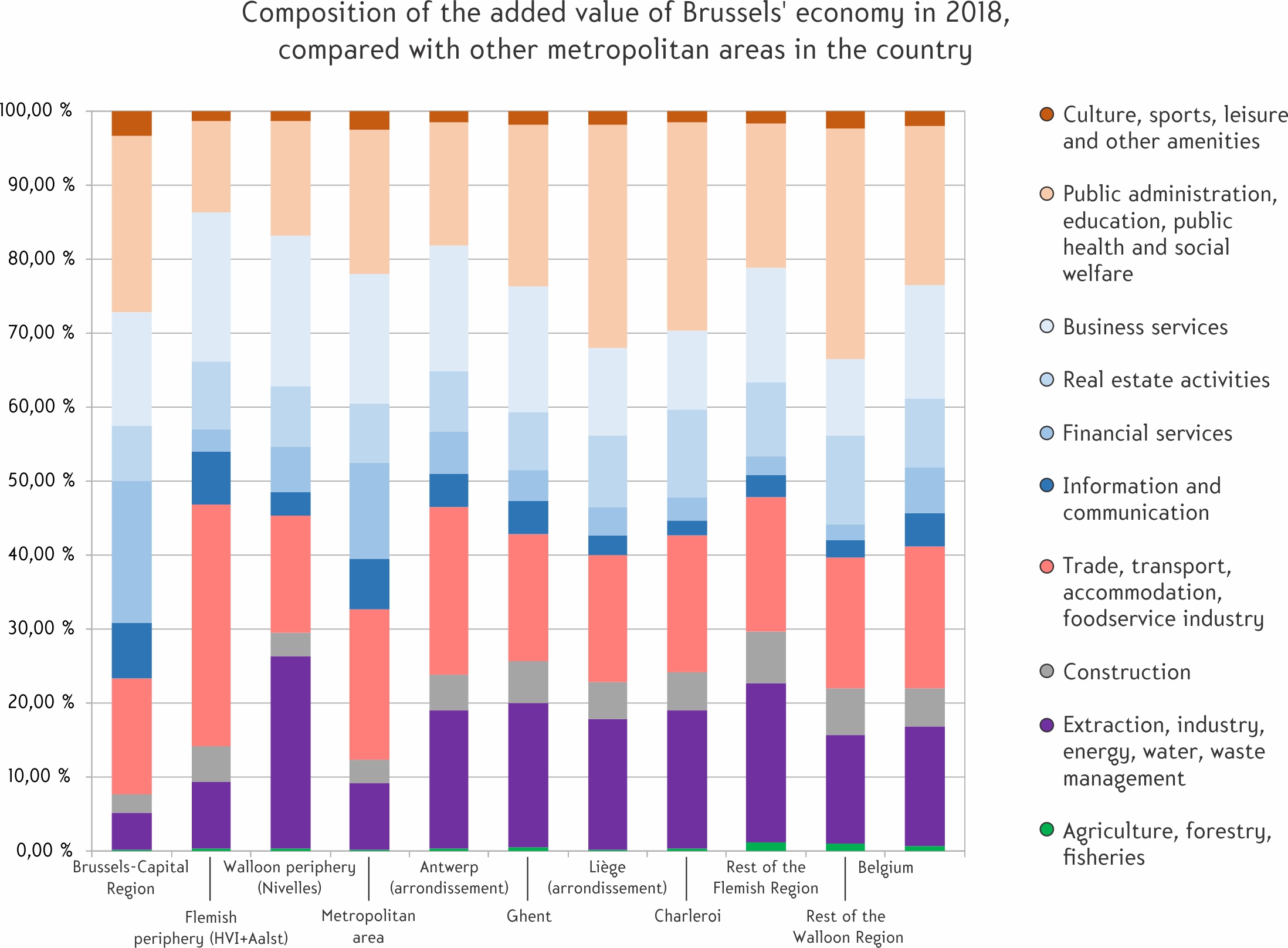
Based on VANDERMOTTEN C., Bruxelles, une lecture de la ville. Brussels, Éditions de l’Université de Bruxelles, 2014, p. 55. Infographics developed using national accounts.
If you look carefully at the first bar of the graph, you will see that the share of industry in Brussels is very low. Moreover, these are often head offices rather than production sites, with the exception of SABCA in the aeronautics sector and the astonishing survival of the automotive industry (Audi Forest), the pharmaceutical industry and the manufacturing of electrical equipment. If you compare this bar with the adjacent ones, you will immediately notice that the cities of Antwerp, Ghent, Liège and Charleroi remain much more industrially oriented.
In contrast, the administration and service sectors constitute a significant part of the Brussels economy, reflecting the concentration of central and command functions in the capital. Such a large share of services cannot be found in Antwerp or Ghent.
For the next exercise, take a close look at the fourth bar (the Brussels metropolitan area).
Do you have a suggestion, comment or remark about this activity? Click here!