Activity 8: A labour mobility marked by commuters, within a vast employment basin

Brussels, the city of traffic jams?
Activity 8: A labour market marked by commuters, within a vast employment basin
In Belgium, commuting to and from work is a daily routine for many. As you have seen, the Brussels-Capital Region is the workplace of almost 700,000 people, accounting for 15.6% of national employment, in an area inhabited by only 10.5% of the population. For this reason, mobility is clearly a crucial challenge for the Region. This even more so since the number of jobs increased by 8.2% from 2000 to 2016. Every day, the capital welcomes 345,000 commuters from the other two Regions; 31% of workers in Brussels reside in the Flemish Region and 17.6% in the Walloon Region. The map below, which you are starting to get familiar with, confirms this reality.
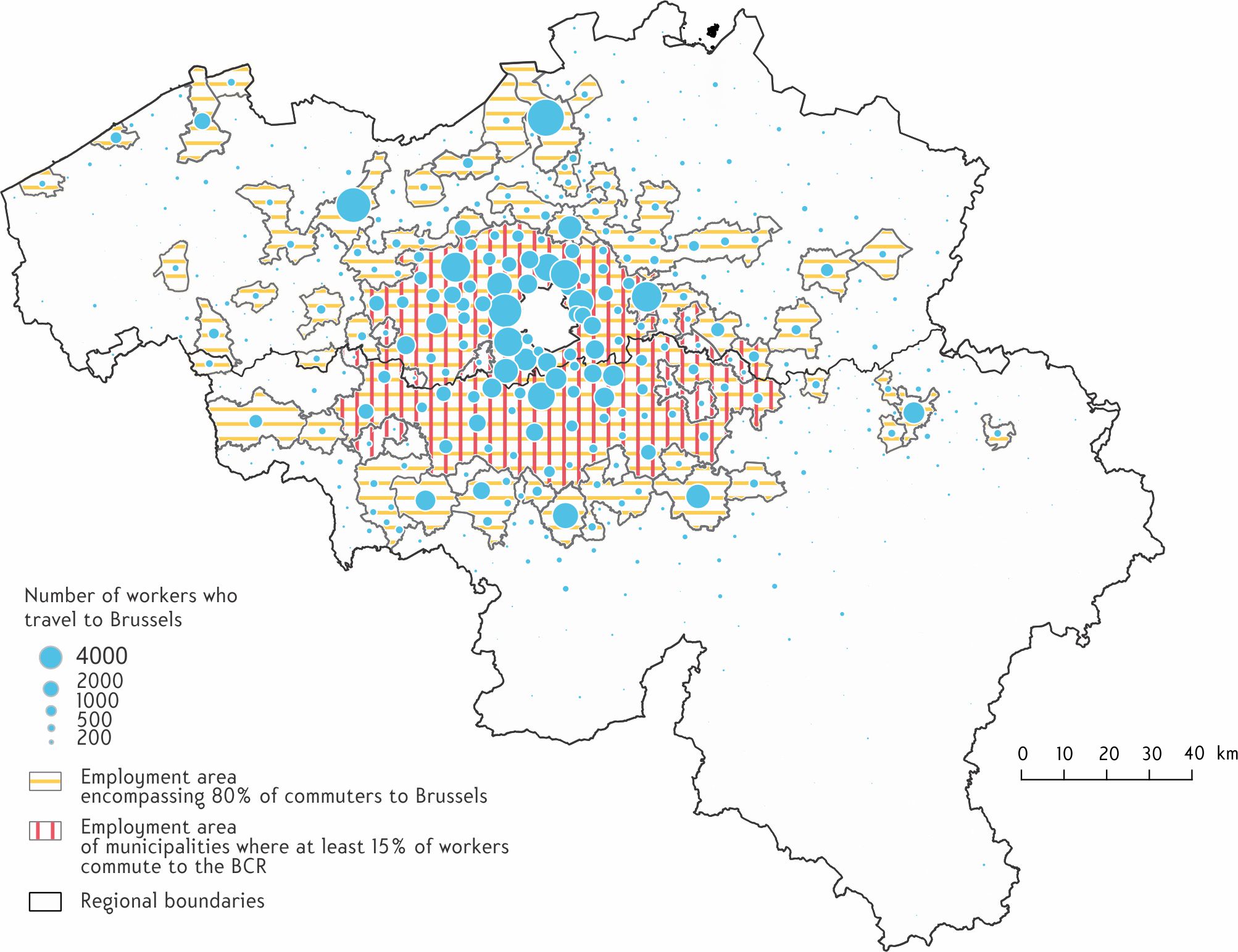
Map showing the share of commuters in Brussels. Source: ERMANS Thomas, BRANDELEER Céline, D’ANDRIMONT Caroline, HUBERT Michel, LEBRUN Kevin, MARISSAL Pierre, VANDERMOTTEN Christian and WAYENS Benjamin, 2019. Analyse des déplacements domicile-travail et domicile-école en lien avec la Région de Bruxelles-Capitale. in Cahiers de l’Observatoire de la mobilité, n.6 [online]. Brussels: Brussels Mobility - Brussels Regional Public Service.
Of course, in Brussels as elsewhere, work-related commuting represents only part of the total mobility, being characterised by its own limitations, both in terms of space (between home and work) and time (relatively fixed working hours). It also has a major impact on the other types of travel (inhabitants of the Region, passing vehicles, etc.). To understand the significance of issues related to commuting, we suggest you to read another excerpt from the e-journal Brussels Studies on this topic:
"A residential location far from one’s place of work, for example, is determined by economic necessities (cost of housing, professional instability, etc.), a dream (a detached house), a social status to protect (appeal of the green suburbs) or a need for roots in a territory. These residential situations depend on land-use planning policies which lead to the scattering of the housing environment and make the implementation of true alternatives to car use nothing but an illusion, following the gradual dismantling of the exceptional railway and byroad network which existed in industrial Belgium. The implementation of more sustainable mobility for companies and their workers suffers because of the institutional division of Belgium and lack of coordination between levels of authority, in particular at metropolitan level in Brussels. This division also allows contradicting policies to be maintained. Thus, as long as the tax regime for companies favours the availability of company cars and petrol cards as it does now, it will be very difficult to balance this advantage with other measures which favour the use of alternative modes of transport or a location policy for companies as well as workers, which is more in keeping with sustainability demands."
For a more comprehensive presentation of this discussion, we suggest you to read the article which this excerpt was taken from: Thomas Ermans, Céline Brandeleer, Michel Hubert, Kevin Lebrun and Florentine Sieux, "Travel between home and work: current situation and perspectives for action for companies", Brussels Studies [online], Synopsis, No. 125, published online on 2 July 2018.
As you have read, the high number of company cars in Belgium (650,000 in 2016) exacerbates the mobility problems in and around the country's major cities. They account for 27% of car traffic for commuting to and within the Brussels-Capital Region. To get an idea of their contribution to congestion, just note that experts have calculated that a 10% reduction in company cars would lead to a 40% reduction in car congestion!
The company car system is closely linked to other factors that you have seen above, such as the recruitment area (the employment basin) which extends far beyond the administrative boundaries of the Brussels-Capital Region, commuter traffic, the variety of economic activity sectors as well as their connection to the public transport network.
On the whole, there are three types of companies in Brussels that offer company cars to some of their employees. Link each of these three types to the following maps. Pay attention to the location of the companies and use the written information (see below).
If you want to find out more about the profiles of companies that use company cars in the Brussels-Capital Region, read the following article: https://journals.openedition.org/brussels/1542.
Good Move plan
In 2019, the Brussels-Capital Region adopted a new regional mobility plan: Good Move. Its aim is to prolong the vision of the previous plan (IRIS 2) for a more sustainable mobility, in particular by reducing the pressure of traffic on the Region's territory. The Good Move plan proposes a series of concrete measures to achieve this. Can you identify (below) whether these measures are aimed more at the inhabitants of the Brussels-Capital Region, at residents of the near periphery or at commuters coming from further afield?
Do you have a suggestion, comment or remark about this activity? Click here!