Activity 6: A labour market disconnected from the inhabitants?

Brussels, the city of traffic jams?
Activity 6: A labour market disconnected from the inhabitants?
Even though the role of national and European capital has led to the creation of many jobs in Brussels (linked in particular to the concentration of embassies, international institutions and financial holding companies), there is a major disconnection between these sectors and the employment needs of the region's population. The major role of the city's international functions should not obscure the fact that trade, personal services and non-market services (hospitals, education, etc.), which constitute the sectors of residential and presence-based economies, provide employment for many inhabitants of Brussels.
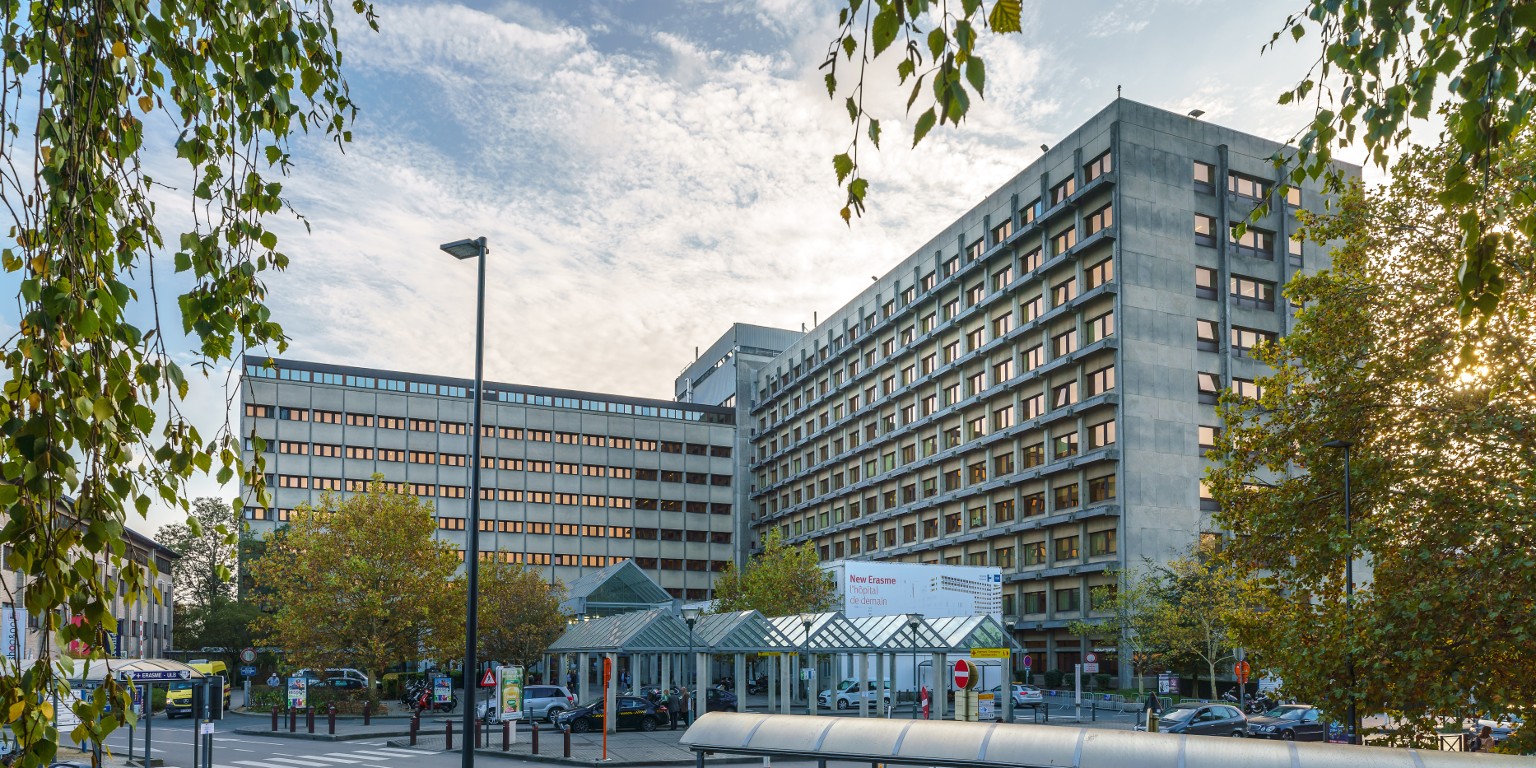
The Erasmus Hospital in Brussels. Brussels is a major hospital centre, providing services that extend far beyond the Region. © Frédéric Raevens.
Since the 1990s, the nature of Brussels' socio-economic problems has changed somewhat. The industrial crisis has been overcome and Brussels is once again doing very well economically, better even than the national average and the other Belgian cities (with the exception of Ghent). Nevertheless, social inequalities are on the rise and social indicators continue to deteriorate. As you can see in the following graph, unemployment is increasing and becoming structural. The unemployment rate in Brussels is significantly higher than in the other two regions.
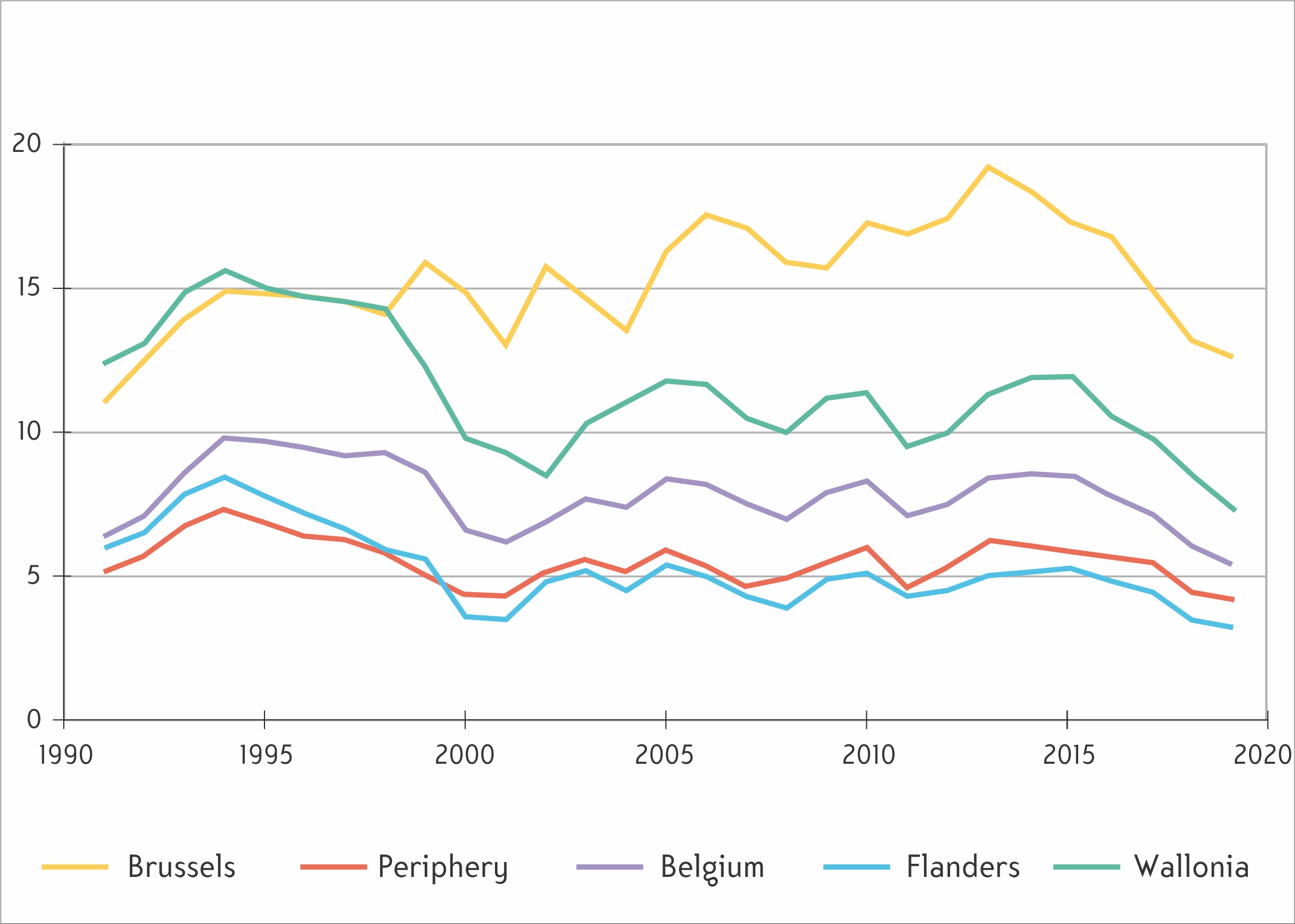
Evolution (in %) of the unemployment rate in Brussels, its periphery (Hal-Vilvoorde and Walloon Brabant), Flanders, Wallonia and Belgium, between 1991 and 2020. (Unemployment rate based on the EUROSTAT definition - Labour Force Survey - from 1999, with an adjustment between 1991 and 1998). Source: VANDERMOTTEN C., Bruxelles, une lecture de la ville. Brussels, Éditions de l’Université libre de Bruxelles, 2014, p. 66.
You must be wondering what the causes are of this paradox: Brussels being a wealth-producing city, but also a city with major socio-economic challenges. To discover the answers, read the following excerpt:
How economic growth creates social inequalities
"Firstly, the contemporary growth model appears more and more to generate exclusion as well as social inequalities [...]. It involves a significant break with the post-war growth model which generated full employment and was accompanied by a considerable decrease in social inequalities. For Brussels, we have shown the very strong growth in skilled employment and the decrease in low-skilled manual employment. [...] [D]uring the 1991‑2001 period, this resulted in the growing exclusion of low-skilled people from the labour market. But this mechanism alone probably does not account for the complexity of the evolutions observed [...]. The low-skilled jobs created in the service sector stand out due to their precariousness and feminisation, as well as the low level of organisation of the employed workers (social sector, retail trade, hospitality business, construction, etc.) [...]. This results in a general decline in the situation of low-skilled workers. Let us also point out that this growth model generates few jobs, with the result that in the Brussels-Capital Region a 1% growth in added value only leads to a 0.5% growth in employment. Secondly, [...] the growing sociospatial inequalities add to the difficulties of people who live in the most disadvantaged neighbourhoods. All things being equal in terms of nationality, age and education level, they have a much higher likelihood of being unemployed. Consequently, the very high spatial concentration of people in difficulty in Brussels – at a much higher level than in the other Belgian cities – probably increases the social difficulties."
This text is an extract from an article published online in the electronic journal Brussels Studies. If you want to know more, we strongly recommend you to read the entire article: Gilles Van Hamme, Isaline Wertz and Valérie Biot, "Economic growth devoid of social progress: the situation in Brussels", Brussels Studies [Online], General collection, No. 48, published online on 28 March 2011.
Do you have a suggestion, comment or remark about this activity? Click here!