Activity 2: Brussels Park, the heart of national politics

Brussels, administrative city and spy nest?
Activity 2 : Brussels Park, the heart of national politics
Concentration of institutions and powers: a multi-capital city
Brussels already had the function of a capital long before the creation of the Belgian state in 1830, although it was often in competition with other cities, such as Mechelen or Leuven. Brussels therefore played a leading role in the Duchy of Brabant (1183-1482/1795), the seventeen provinces of the Habsburg Netherlands (1482-1556) that later became the Spanish Netherlands (1556-1713), the Austrian Netherlands (1713-1795) and finally the United Kingdom of the Netherlands (1815-1830).
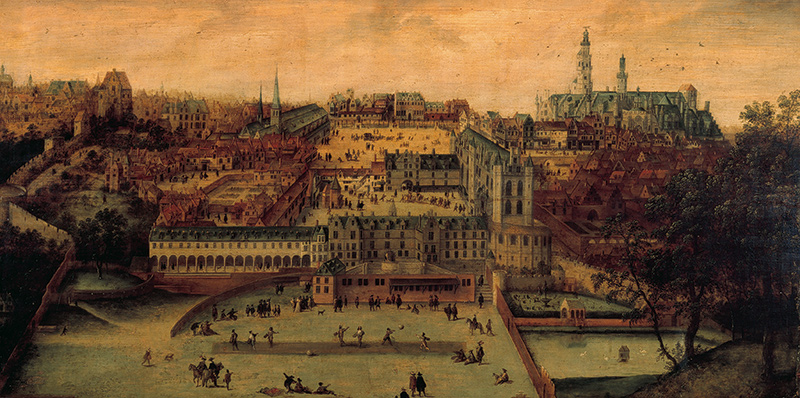
The Coudenberg Palace, located on what is today the site of the Place Royale/Koningsplein, was the seat of power from the 12th to the 18th century. Oil on canvas attributed to Lucas Gassel, 16th century, Royal Museums of Fine Arts of Belgium.
It was not until 1830 that Brussels became, for the first time, the sole capital of a new state: Belgium. After the Second World War, its role continued to evolve towards that of a multi-capital city. In other words, it became the capital of several separate political entities.
This evolution can be explained by two processes:
- on the one hand, the "federalisation" of the Belgian State, a transformation that has given rise to the birth of "federated entities" called Regions and Communities that you have already learned about;
- on the other hand, the "supranationalisation" linked to the development of the European institutions.
On the legislative front, there are now eight parliaments active in Brussels. They are linked to eight different political entities: the European Union, Belgium (Senate and House of representatives), the Flemish Community, the French Community, the Brussels-Capital Region, the French Community Commission (which, as you will see below, consists of the French-speaking members of the Parliament of the Brussels-Capital Region) and finally the Common Community Commission.
Using the animation below, determine which parliaments are present in Brussels.
Parliaments in Brussels
Fragmentation of power
Part of the complexity of Brussels is due to the gradual federalisation of the Belgian unitary state since 1970. As you have previously learned, two different types of 'federated entities' were created: Regions and Communities.
This development is linked to the fact that in the decades following the Second World War, political decision-makers wished to respond to very different demands: on the Flemish side, a desire for greater control over education and culture, and on the Walloon side, the same desire for control over economic instruments.
Each type of federated entity was accordingly gradually given different powers. Broadly speaking :
- Regions manage a large part of the issues related to territory, such as the economy, employment, mobility, etc... ;
- Communities are responsible for people-related aspects (often referred to as "person-related matters") such as education, culture, social policy, etc.
The result is an asymmetrical system because the territories of these "federated entities" overlap with each other to a certain extent. In Brussels, one Region (the bilingual Brussels-Capital Region) and two Communities (the French Community for Francophone policy and the Flemish Community for Flemish policy) are active on the same bilingual territory.
To refresh your memory, don't hesitate to go back to Section 1: Brussels, capital of what?
The contemporary spectacle of power
The various public authorities present in Brussels showcase their power, in particular through the choice and location of their buildings (parliaments, governments, administrations), as well as through symbolic emblems (such as a flag) which they use for communication purposes.
The map below shows you five types of actors present around the Brussels Park, a symbolic political hotspot in Brussels.
On the following map and using the information shared in the previous point, find the following institutions: the Royal Palace of Brussels - the Palace of the Nation - the Flemish Parliament - the Parliament of the French Community - the Academy - the Office of the Minister-President of the Brussels-Capital Region.
Cartography: Société Royale belge de Géographie
Do you have a suggestion, comment, remark about this activity? Click here!