Activity 4: Discussions over new and old places of power

Brussels, administrative city and nest spy?
Activity 4: Discussions over new and old places of power
The buildings of public authorities are objects of the political culture, a mirror of the power that their tenants hold. They therefore have explicit and implicit meanings. In other words, their location in the city is not only functional, but also carries an underlying political message (for example, the desire to be highly visible in the heart of Brussels). In this way, all the symbolism (i.e. the flags, the architecture of a building, its name, etc.) is part of the communication strategy of the relevant public authority.
Discover in the following paragraphs the visibility policies that have been implemented by different authorities in Brussels.
The Martyrs' Square
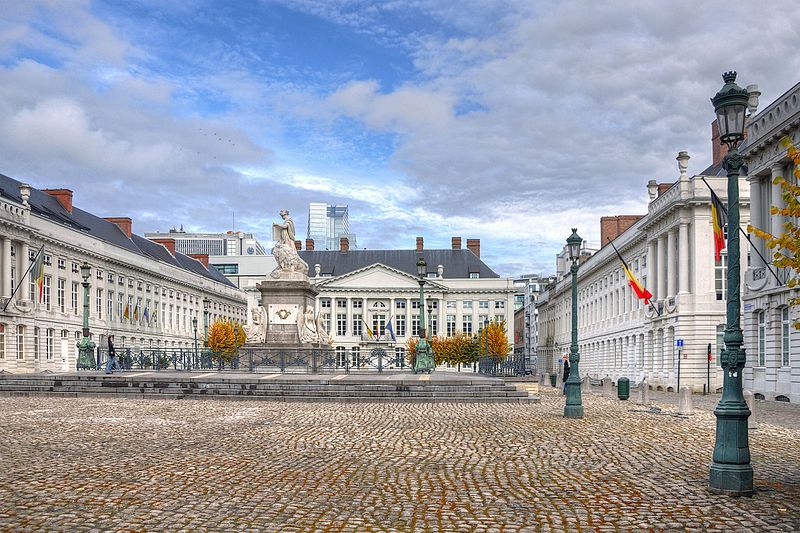
The Martyrs' Square in Brussels
© Giorgio Galeotti, CC BY 4.0
The Martyrs' Square (former Saint-Michel Square) was built between 1774 and 1776. It is a prime example of neo-classicism in which one can admire the symmetry, the uniformity of the shading, the similar roof heights, etc. It was in 1831 that it was given its current name of Martyrs' Square, as a tribute to the victims of the Belgian Revolution of 1830. In 1994, the Flemish government transferred several of its ministerial offices to this square. A choice that is anything but insignificant: the 1995-1999 policy letter of the Flemish government in Brussels states: "Where the heroes of the Belgian Revolution are buried, the flag of the lion now flies".
This quote perfectly illustrates the fact that the choice of the location of government institutions in the city is no accident, but a deliberate policy for better visibility. It is interesting to note that the French Community Commission (COCOF) quickly decided to finance a theatre and a bookshop on the same square.
On the following map, you can find the different components of the Martyrs' Square.
Tour & Taxis : a strategic area for Brussels
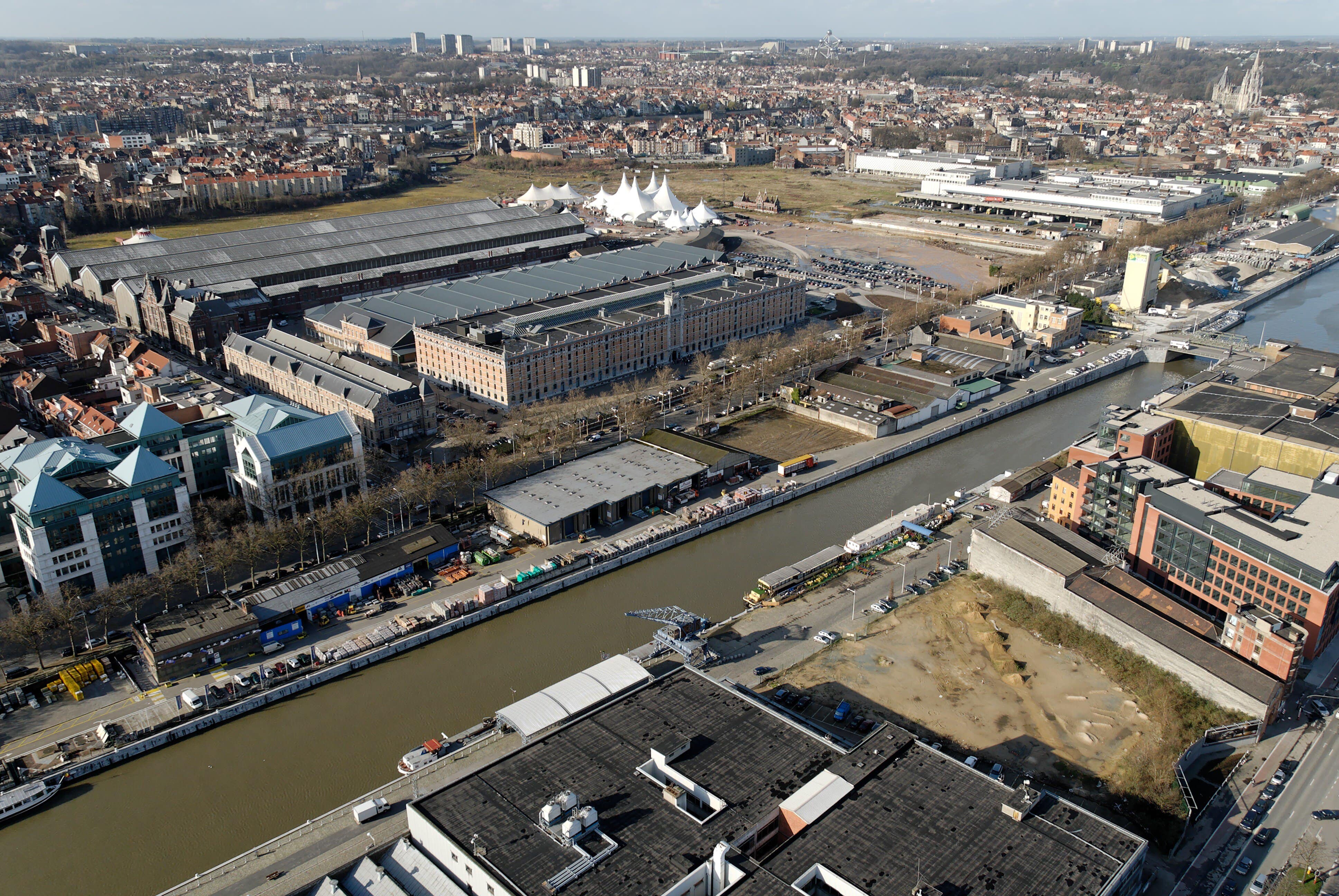
Aerial view of the site of Tour & Taxis (2006). © Port of Brussels
In 1897, the municipality of Brussels annexed part of the port area at the expense of the municipalities of Laeken and Molenbeek-Saint-Jean/Sint-Jans-Molenbeek. From 1900 onwards, the Tour & Taxis site was built there using the most modern techniques and materials of the time. Overlooked by the superb Entrepôt Royal, visible from the city and adjacent to Entrepôt A (whose roof structure is an architectural feat) and by one of the largest freight stations in Europe, this maritime station, completed in 1910, is the work of architects Constant Bosmans and Henri Vandeveld.
The site became an important national and international hub for the storage, transshipment and customs clearance of goods. The last logistic activities ceased in 2000 and the buildings were then reconverted. Around 40 companies have settled in the Entrepôt Royal. The rest of the space is used to host major public events (i.e. book fair, antique fair, etc.). This multifunctional site is also intended to accommodate housing, the buildings of several administrations and a public park.
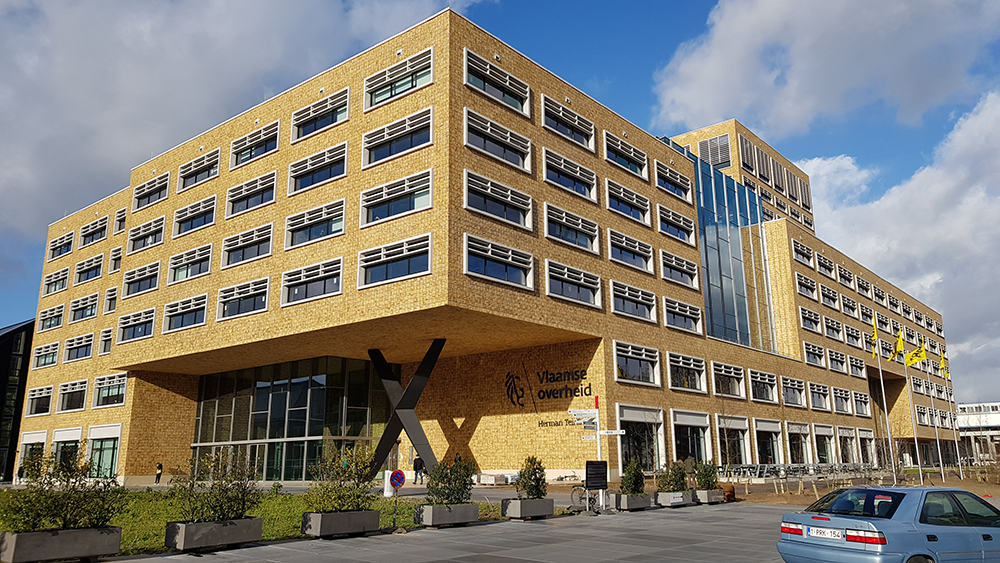
The Herman Teirlinck office complex, Avenue du Port/Havenlaan in Brussels. © Romaine, CC0
In 1997-1998, the Flemish government's desire to develop a policy of "recognisable presence" in Brussels had already led it to group together some 24,000 civil servants in buildings along the current Avenue du Roi Albert II/Koning Leopold II-laan, near the North Station. More recently, it chose to move part of its administrative services to the prestigious Tour & Taxis site. The new office complex (2,500 civil servants), the ''Herman Teirlinck Building'', - a reference to a Molenbeek-born founder of the Antwerp theatre school - was thus established on the Avenue du Port/Havenlaan. Once again it illustrates the long-term nature of the Flemish government's real estate choices. It is its way of emphasising that it ''will not let Brussels go''.
It is interesting to note that the Flemish building is adjacent to the building of Brussels-Environment (Bruxelles-Environnement/Leefmilieu-Brussel), which in its own way testifies to the desire of the Brussels-Capital Region to assert its presence on this very beautiful site.
Using the map below, discover all the emblematic buildings on the Tour & Taxis site.
Do you have a suggestion, comment, remark about this activity? Click here!