
Activity 7: Putting nature to the test: regulation and ecological struggles

Brussels, Europe's greenest capital?
Activity 7 - Putting nature to the test: regulation and ecological struggles
The many global crises we are experiencing today (climate change, loss of biodiversity, depletion of resources and fossil fuels, armed conflicts, health and humanitarian crises) mean that we urgently need to find collective solutions and act at different levels (local, regional, global). Faced with the scale of the threats and the urgent challenges we face, some people feel a great deal of distress known as eco-anxiety.
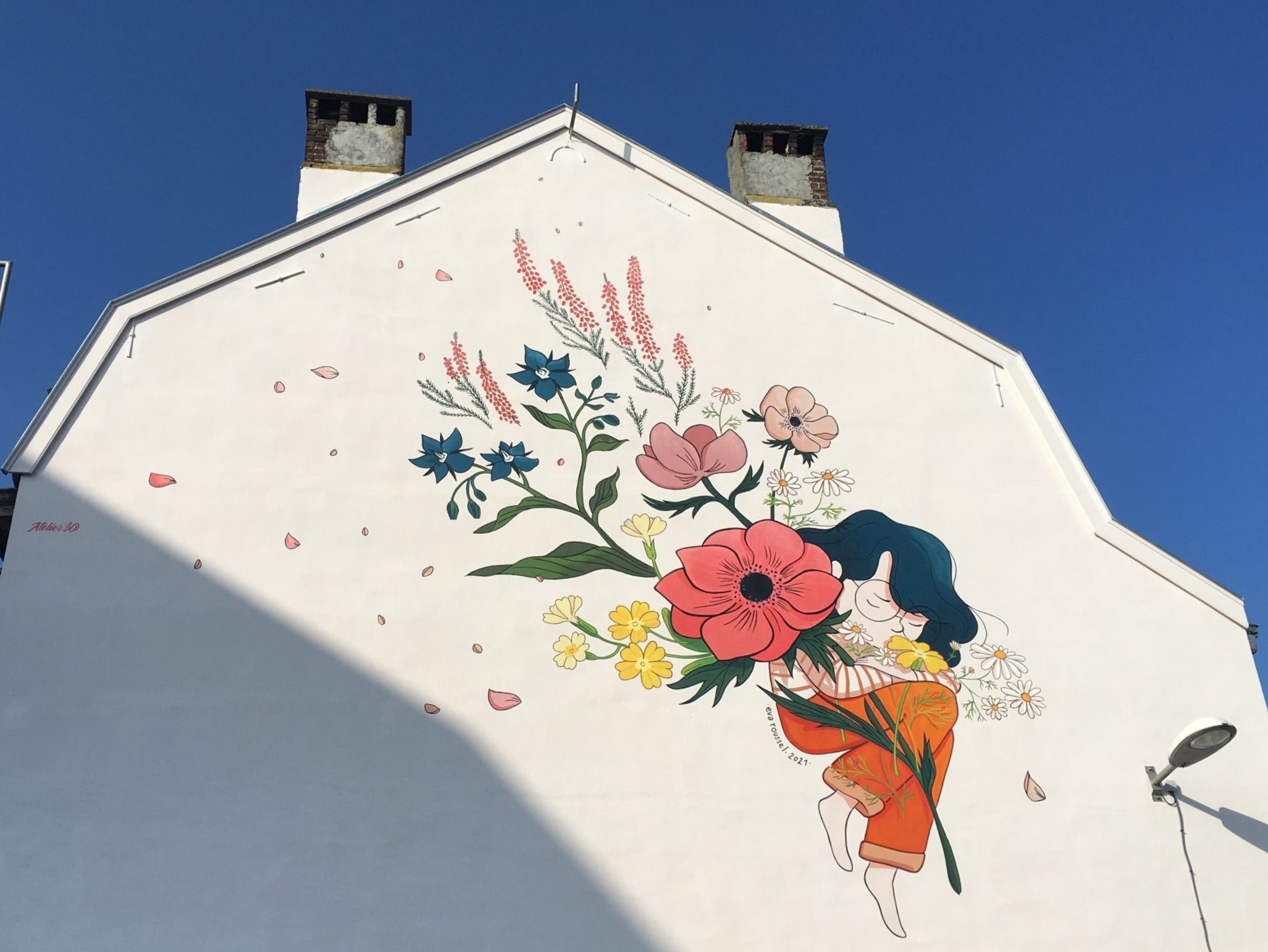
Picture: Fresco by Eva Roussel entitled "Solastalgie", part of the Parcours BD, inaugurated in Laeken in 2021. "Solastalgie" comes from the words "solace" and "-algie", meaning the fear of losing something. The author explained at the inauguration that the flowers depicted in the fresco were not chosen at random. She chose camomile for soothing and anti-anxiety; borage for courage and action; anemones for hope and protection; heather for the joy of community; and primroses for renewal and youth. © City of Brussels Comic Book Route. Online: https://www.parcoursbd.brussels/fresques/solastalgie/
The concept of eco-anxiety was first described in 1997 by Belgian-Canadian researcher Véronique Lepaige. She explains that it is an illness, an individual suffering with associated disorders. Some people become phobic and extremely anxious. This anxiety leads to worry, vigilance, anger and a feeling of powerlessness.
Does this description concern you? Do you feel fatalism, a deep sense of discouragement, anger and anxiety when you think about climate change? If so, don't be left alone with these extremely heavy thoughts. You can seek help from psychologists or join action groups, of which there are many in Brussels!
Yet there are people in society who are taking action and mobilising to meet these challenges and combat the effects of climate disruption. This ability of groups and communities to thrive and unite in times of crisis is known as "co-resilience". The role of organisations and citizens is essential. Having looked at many aspects of the environmental context in Brussels, we will now look at nature through the prism of the institutions, organisations, collectives and associations that are trying to manage the environment in Brussels, to regulate it, to initiate action, to mobilise and to challenge certain choices.
1. Regulating the environment in Brussels
The Brussels-Capital Region was created in 1989. This fairly recent institutionalisation has enabled the various environmental issues to be taken into account in a more cross-cutting way. The Region therefore created a public service for environmental management: Brussels Environment (BE - Bruxelles Environnement in French). Now located in a passive building at Tour & Taxis, Brussels Environment has more than 1,300 employees and produces a large number of surveys, publications and data on the environment in Brussels, some of which were used as sources for this section. Listen to this short interview with Serge Kempeneers, former Director of Brussels Environment, who in 2023 was the President of the Environment Council of the Brussels-Capital Region:
[after starting the video, choose at the bottom right: settings > subtitles > automatic translation > English]
Brussels Environment is responsible for implementing the Region's environmental policy in three areas: protecting natural resources; managing the land in a more environmentally-friendly way; and combating climate change in Brussels. It brings together the following areas of activity under a single umbrella:
- Fauna and flora: nature and biodiversity, management of green spaces and natural areas, management of non-navigable waterways, animal welfare.
- Sustainable transformation: the fight against climate change, an integrated approach to a sustainable city, rainwater management and flood control;
- Acting eco-responsibly: sustainable food and urban agriculture, waste management planning and circular economy, sustainable production, construction and consumption.
- Health protection and renovation: electromagnetic waves, noise and vibration pollution, asbestos, soil, air quality, energy.
In these areas, Brussels Environment is the administration responsible for regulating environmental issues. In addition to monitoring and keeping an eye on changes in these issues through studies, BE discourages certain behaviours (for example, by penalising non-compliance with the permitted decibel threshold for overflying aeroplanes) and encourages other behaviours (for example, by awarding financial incentives for the renovation of poorly insulated buildings).
2. Initiate
The Brussels-Capital Region also encourages certain initiatives with its Good Food strategy which was adopted in 2015 and which aims in particular to encourage agroecology (an agricultural technique that seeks to strengthen the ecosystem), promote healthy eating (particularly in school canteens) and encourage households to produce their food in small urban vegetable gardens.
Numerous private and collective vegetable gardens, as well as professional market gardens, are emerging in Brussels, developing the food production by individuals and short-chain distribution. In 2018, 15% of Brussels residents said that they produced part of their own food, while Brussels Environment made 373 plots available to residents for vegetable gardening. You can see them in the following dynamic map of Brussels Environment.
Collective and family vegetable gardens (2018)
In 2018, the Brussels-Capital Region had 392 vegetable garden sites, which is 30% more than in 2013. However, this evolution was accompanied by a 4% drop in the total area of these sites. The supply varies greatly by municipality with the two extremes being Evere (1.6 m2/inw.) and Saint-Josse (0.03 m2/inw.). Between 2013 and 2018, the surface area and number of vegetable garden plots available to Brussels residents, located in green spaces managed by Brussels Environment, increased by 61% and 81% respectively for a total gross surface area of 5.3 ha for 373 plots. The creation of kitchen gardens is also encouraged through numerous project calls addressed to different target groups. Source : BRAT, 2019

3. Contesting and mobilising
Alongside the vegetable gardens, urban agriculture is also being practised by professional gardeners in Brussels. There aren't many farms, but their presence in the heart of a capital is exceptional. Their settlement is generally hampered by the lack of available space in metropolises under heavy real estate pressure, as well as by the price of land.
To address this crucial issue in agriculture, associations such as Terre-en-vue buy up farmland and then make it available to farmers at rents established outside the market, i.e. at very affordable rates. Terre-en-vue has acquired a number of plots of land in Brussels and its immediate surroundings and has enabled a variety of actors to settle and set up and grow fruit and vegetables: CourJette, Hierba Buena Tisanes, les Garçons Maraîchers, Les Simples Jettoises, RadisKale, Smala Farming, Voie lactée and the Chant des Cailles farm. Other Brussels farms combine market gardening with social missions, such as Ferme Nos Pilifs, which employs people with disabilities, Début des Haricots, Ferme du Parc Maximilien and Maison verte et bleue. There are many other relevant actors who have settled in Brussels, such as Atelier Groot Eiland, which developed "FleurAkker", a field of flowers in Jette where anyone can come pick and create their own bouquet between March and October. An association has been set up to bring together urban agriculture professionals in Brussels: FedeAU.
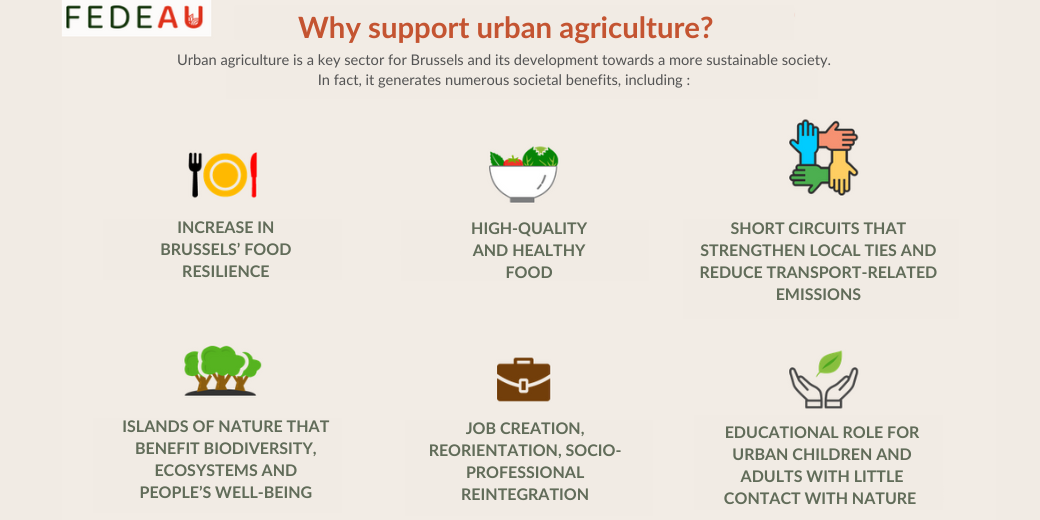
Alongside these bodies, citizens have also played a role in environmental management in Brussels, both in initiating new projects and in mobilising, but also in challenging practices or ambitions that run counter to the environment.
Wasteland provides an example of how citizens are challenging environmental management. Over the years, a number of wasteland sites have been transformed into areas for urban agriculture, or even territories where fauna and flora of high biological value were able to develop spontaneously. However, although these areas have not been used for some time, their future is the subject of divergent interests. In a metropolis like Brussels, where vacant land is scarce, the competition to find space for housing, recreation, productive activities, offices or community infrastructure is a direct threat to wasteland. Often, a trade-off has to be made between densifying and greening. Decision-makers and property developers see wasteland as a land resource for potential densification, while naturalists see it as an essential source of biodiversity for the urban ecosystem.
If you look closely at the new urban projects around you, you'll see that the battle over wasteland is not a new one. One example is the former Keelbeek, which gave way to the Haren prison. Look at these aerial photos to see how the land has changed over the years, by moving the cursor to the right:
This former farmland was left to lie fallow before being occupied by vegetable gardens and other activities during the protests, to mark their interest in preserving the land. No doubt the symbolic weight of the chosen infrastructure (a prison) played a part in the intensity of the protests, especially as this is the largest prison in the country.
Mobilisation against the Keelbeek prison project:
Other fallow land is still being contested, such as Josaphat, Champ des Cailles and Marais Wiels. In some cases, negotiations have made it possible to preserve (part of) the open space.
Many citizens are aware of environmental issues. But not everyone mobilises by camping out on a wasteland to prevent its destruction! There are other ways of getting involved or challenging certain decisions. Although the indicator may be misleading, the evolution of environmental concerns within political parties, and the evolution of the Ecolo-Groen faction in Brussels, shows that these concerns are becoming increasingly important to voters. Quite a few parties have understood this and are now also proposing answers to the climate crisis. Today, Ecolo-Green is no longer the only party addressing climate change.
In 1982, the Ecologists first appeared on 16 municipal electoral lists in the Brussels agglomeration (which became the Brussels Capital Region in 1989). On average, they obtained 6.0% of the votes in the agglomeration (Rowies, 1983). Since then, their political influence has grown, which translated into mayors and aldermen of Ecolo-Groen in some Brussels municipalities between 2018 and 2024 .
A wide range of actors are involved in environmental issues in Brussels: institutions such as Brussels Environment, but also groups, associations, citizens, researchers, etc. These actors are not only numerous, they are highly responsive as well. While some structures have existed for many years, such as Inter-Environnement Bruxelles, which was set up in 1974, we cannot provide a complete list of existing initiatives, or we would have to update it several times a year!
What we think is essential to remember here is that Brussels is a breeding ground for many initiatives that are mobilising, raising awareness, challenging and trying to protect the environment and nature in the city. This section has shown you, through a number of aspects, the vital importance of this environment in an urban setting to counter, reduce or resist climate change and its consequences.
But we shouldn't believe that all people living in Brussels agree on this issue. There is a significant proportion of the population that is not sensitive to these issues, or even oppose them head-on. Various examples in Europe show that these tensions need to be taken seriously: for example, the exceptional drought in Spain in early 2023 led to very aggressive popular reactions against the Spanish meteorological agency, which was accused of spreading fake news; in May 2023, French President Emmanuel Macron, quickly followed by Belgian Prime Minister Alexander De Croo, called for European measures to protect the environment to be "paused" so as not to have too severe an impact on business and rural sectors; the "nitrogen" plans introduced by the Netherlands and the Flemish region in 2022 led to very virulent reactions from farmers, with sometimes serious political consequences; tractor demonstrations across Europe in early 2024...
Environmental issues in Brussels and elsewhere remain highly sensitive but require urgent responses nonetheless.
Do you have a suggestion, comment, remark about this activity? Click here!

