
Activity 4 : Water in Brussels

Brussels, Europe's greenest capital?
Activity 4 - Water in Brussels
As in most large cities, water has played an important role in the development of Brussels: from the development of the city along the Senne to the vaulting of the latter, via the construction of a canal, the development of the many tributaries of the Senne, the construction of public fountains and of water treatment plants... In this activity, we will talk about water in Brussels, its management and development, its quality and finally the access to water.
1. Waterways in Brussels
You saw in Section 1 that the main waterway in the history of the commercial and demographic development of Brussels is the Senne, and in Section 2 that it created a sociological opposition between the east and west of the city. Let's now look at the other sources of water in Brussels. On the following map, you will find all the existing and disappeared springs that have been inventoried in Brussels. Click on the menu at the top left to explore the legend and select existing or vanished sources. Take a close look at the city centre, the Pentagon and the surrounding area. You will notice that there are many more springs to the east.
Map produced by Coordination Senne, available online: Dossier 'Brussels springs'.
Until the 20th century, residents obtained their water mainly from wells, accessible springs in the town or public fountains. Indeed, since the 13th century, the city had developed a majestic network of public fountains in the urban centre. The best known of these fountains is probably ‘Manneken Pis’, whose oldest mention dates back to the 15th century! Brussels also has a large number of streams, both to the east and west, which flow into the Senne. These waterways have had a profound effect on the Brussels landscape and its place names. Take a look at the map below, which shows the river network in Brussels and all the current place names linked to water.
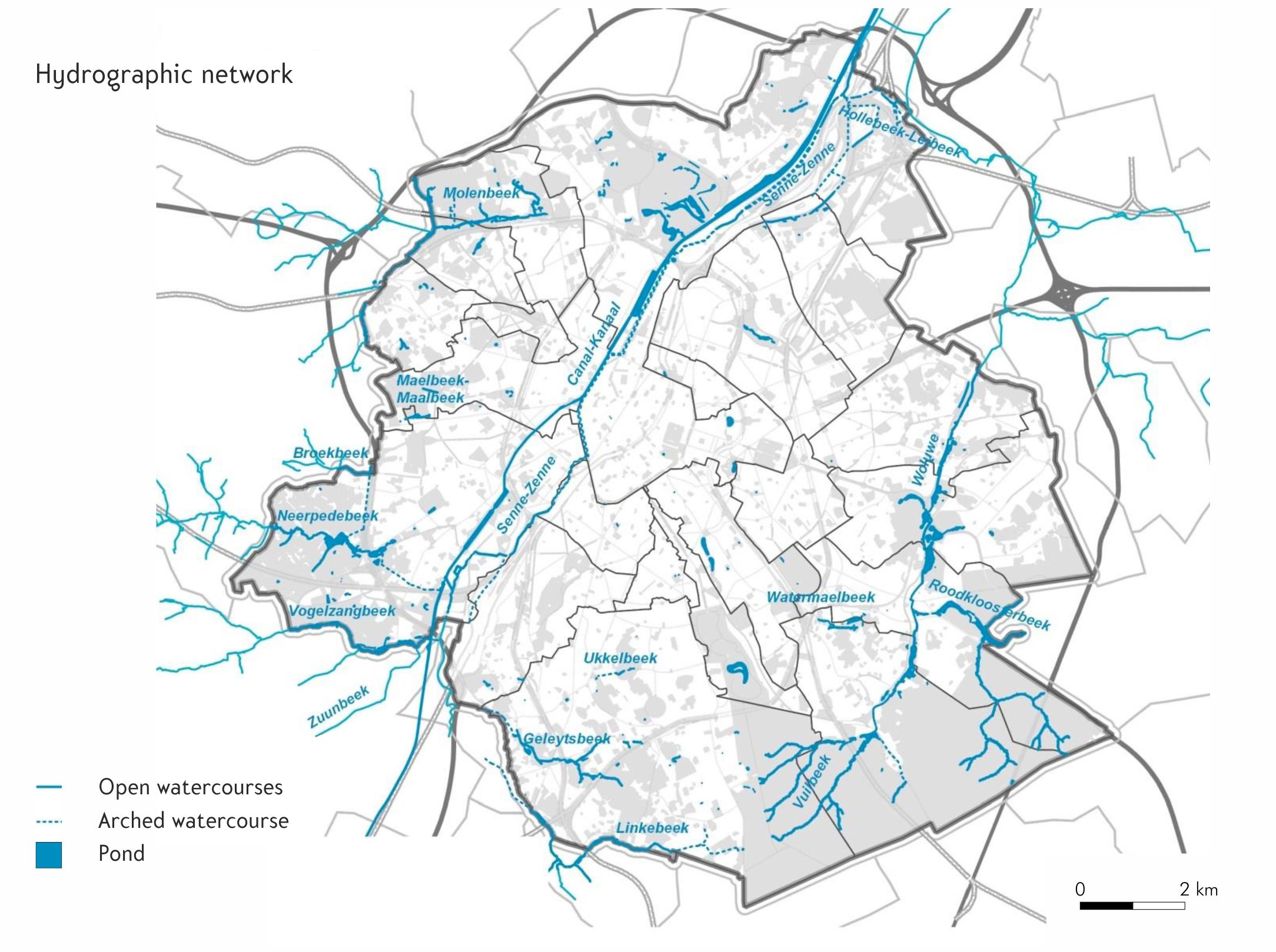
Cartography: Société royale belge de géographie, 2024
2. Water developments in Brussels
Over time, increasing urbanisation was no longer compatible with the frequent and disruptive flooding of these rivers and the marshy areas of their alluvial plains. To overcome these problems, the city authorities began in the Middle Ages to make major changes to the watercourse, notably by building two locks: the Grande Écluse near what is now the Midi Station and the Petite Écluse at what is now the Porte de Ninove. These locks allowed excess water to be diverted into a wide ditch along the city walls known as the « Zinneke » or « Petite Senne ».
On this timeline, you can see some of the key moments of the water management in Brussels. Move the cursor to the right to scroll through the different elements!
To sum up, in the 19th century Brussels sought to control its waterways, even if it meant making them disappear from the city, without tackling the fundamental problems of water pollution and flood management.
If you want to know more about the sewers in Brussels, we invite you to read Ananda Kohlbrenner's article "From fertiliser to waste, land to river: a history of excrement in Brussels", Brussels Studies, Collection générale, No. 78, 23 June 2014. There is also a small book by Martin Angenot, Aude Hendrick and Thérèse Symons entitled "Les entrailles de la ville. Le charme discret des égouts bruxellois" which you can find online. You can also visit the Sewer Museum, an exceptional place to learn more about the history of water management in Brussels.
3. Water quality in Brussels
The Senne has been vaulted since 1871, but that doesn't mean it's any less polluted! Hidden away from view (and noses), pollution of the Senne was no longer a major source of concern. Until 1991, when a European Directive required member countries to treat wastewater from major cities.
Brussels' first wastewater treatment plant (WWTP) went into service in 2000. It can treat wastewater from the equivalent of 360,000 inhabitants. In 2018, major renovation works added biological water treatment. Brussels' second wastewater treatment plant was built in 2007 to the north of Brussels, shortly before the Senne River leaves the Brussels Region. It can treat wastewater from the equivalent of 1,100,000 inhabitants. Together with the treatment plant to the south of Brussels, these two plants are potentially capable of treating all the wastewater from the residents of Brussels and the surrounding area. These two water treatment plants (known as 'STEPs' in French) are not water purification plants, but plants that treat dirty water before discharging it into the river. Most of the water consumed by the people of Brussels comes from catchments in Wallonia. Only 3% of the drinking water consumed in Brussels comes from groundwater in the Forêt de Soignes and the Bois de la Cambre.
The purpose of these WWTPs is to clean up the Senne: they collect the wastewater, filter it in various basins, carry out biological treatment (to remove excess nitrogen, for example, and promote oxygen in the water, which is essential for fish) before discharging the clean water back into the Senne. However, the Brussels sewage system, built in 1848, is a "unitary" system: it collects both wastewater and rainwater. When it rains, the sewer network is saturated and the treatment plants are no longer able to treat all the water. Some of the wastewater is then discharged directly into the Senne, or even into the Canal when it rains heavily, which happens quite regularly in the Belgian capital!
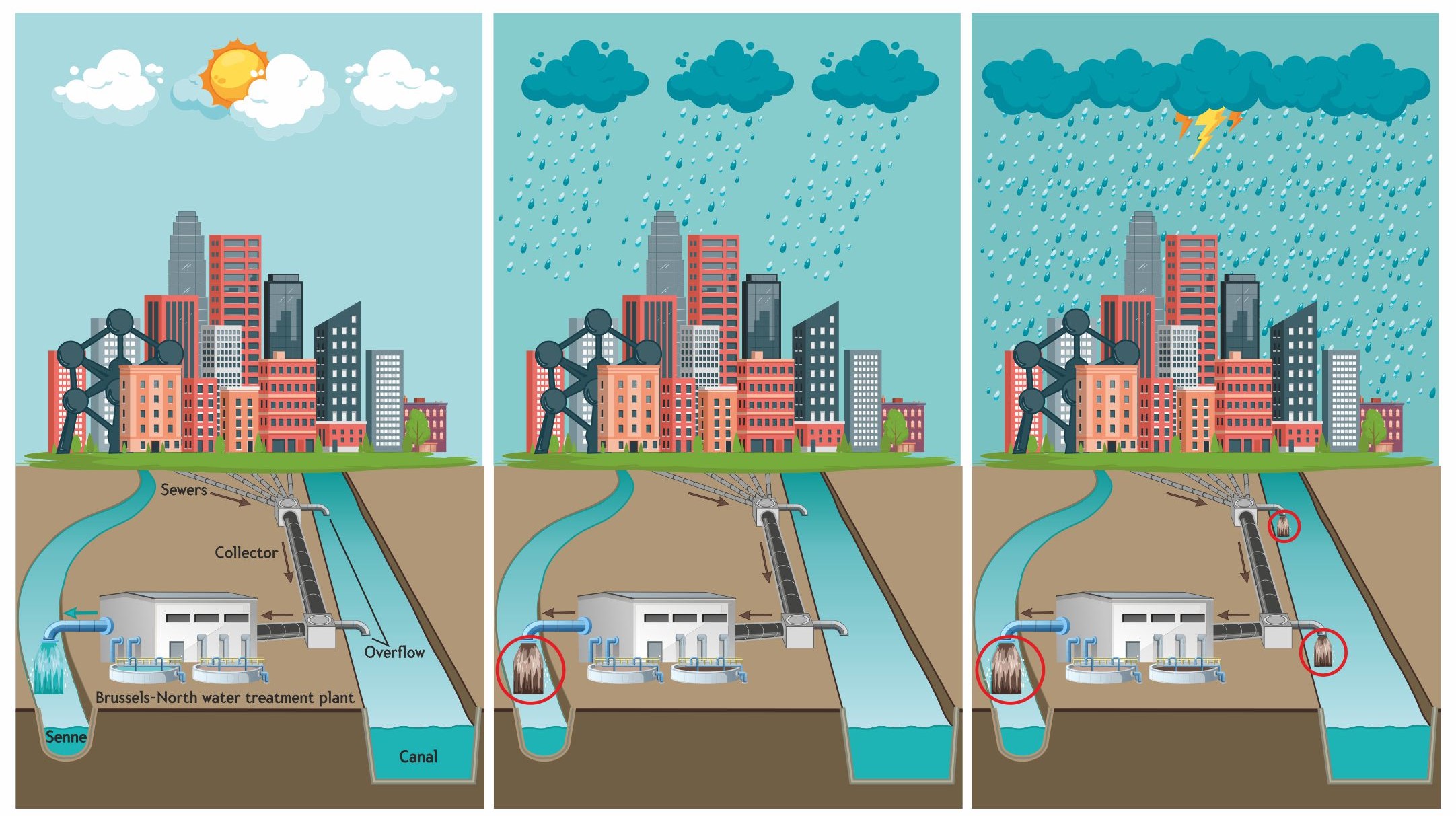
Source: schema produced by the Royal Belgian Cartographic Society, based on schemas produced by Coordination Senne. In 2022, the Canal it up association counted 80 days on which it rained so hard that the treatment plants discharged some of the wastewater directly into the Senne. Of these 80 days, 19 were so intense that wastewater was also discharged into the Canal, in addition to the Senne. Every year, an average of 10 million m3 of wastewater is discharged untreated. By way of comparison, a city like Paris discharged (until 2021) an average of 3 million m3 of wastewater into the Seine.
Are you in Brussels at the moment? Why don't you look out of the window? Is it raining? If so, you can check live to see if the sewers are overflowing into the Senne by going to this page and scrolling down a little to see the monitoring: https://www.canalitup.org/fr/home-fr/
To combat this problem, the Brussels government has adopted the Water Management Plan (WMP) for the period 2022-2027, which is based on European directives. This plan provides for various measures to prevent rainwater from being redirected into the sewer system (including focussing on water-permeable surface coverings and new storm water basins).
Despite these overflows, the installation of the two WWTPs has led to a significant improvement in biodiversity in the Senne. Numerous fish have been observed again after having deserted the river for decades. Move the cursor to the right to see this development!
This rapid improvement in water quality in the Senne shows the significant impact that the Brussels' WWTPs have on aquatic life in our waterways. These results are also due to the other stations and the efforts being made in the Flemish and Walloon Regions. However, according to Bruxelles Environnement, the Senne remains a watercourse of average quality. The water temperature rises by 2°C as it flows through the city, which has a major impact on aquatic life in the river. There are still sporadic instances of critical oxygen levels in the water, lasting a few hours or a few days. Other parameters remain too high for good water quality, such as the presence of various pollutants. And in the event of drought, all the watercourses in Brussels suffer the full force of the deterioration in their quality: the flow of water decreases, oxygen levels fall, concentrations of pollutants increase and aquatic life declines sharply. The rivers of Brussels are therefore not resilient: they are severely affected by droughts and extreme events that are set to become more frequent as a result of climate change.
To improve the quality of watercourses, Bruxelles Environnement has set up a programme called "Maillage bleu", which aims to reopen certain arched watercourses, to renaturalise their banks so that they can absorb excess water in the event of heavy rain, and to disconnect watercourses from sewer systems to allow water to run off into its natural environment rather than overloading the sewer system, leading to discharges into the Senne and even the Canal, as you have seen. In 2017, a vast plan to reopen, protect and develop the Senne was put in place with the support of the European Union and gradually integrated into the urban renewal tools. Among the actions undertaken, it was decided to renovate the banks of a stretch of river to the north of Brussels. Filmed in timelapse, we invite you to watch the progress of this project, which marks a turning point in the history of the river! Look closely at the water level, and you'll see that it fluctuates wildly throughout the project, reminding you of the instability of the Senne's flow:
To get a good idea of the impact of this change, below you find before-and-after photos. Move the cursor from left to right to compare the two photos.
4. Water, a public good
Having talked about the presence of water in Brussels and the facilities put in place by the public authorities, let's now look at the access that the people of Brussels have to water. This includes drinking water, but also water for washing and relaxing (swimming, for example).
(choose full screen in the upper right corner of the time line to guarantee readability)
That concludes this chapter on water in Brussels!
Do you have a suggestion, comment, remark about this activity? Click here!

