Activity 4: Small or large Brussels?

Brussels, capital of what?
Activity 4: Small or large Brussels?
You now know a little bit more about the birth of the city, but the term "Brussels" may still seem slightly unclear to you. It's high time we clarified the terminology.
The City of Brussels and its incremental extensions
The following maps enable you to retrace the gradual expansion of the municipality of Brussels (City of Brussels) since Belgium's independence in 1830. It is important to remember that in the Belgian administrative system, the municipalities constitute the smallest administrative and political subdivisions of the territory. In the course of time, the City of Brussels has grown as a result of a series of annexations. Yet despite this territorial expansion, it only represents one of the nineteen municipalities of the Brussels-Capital Region today. In 2019, the City of Brussels had just over 180,000 inhabitants.
The Brussels-Capital Region
The map below illustrates that the Brussels-Capital Region is one of the three Regions of present-day Belgium. In Belgium, the Regions are administrative and political entities, based on the principle of territoriality. They have a high degree of autonomy in the management of the economy, environment, public works, employment, spatial planning, etc. The Brussels-Capital Region comprises 19 municipalities (including the City of Brussels) and, in 2019, had a population of around 1,200,000. It is surrounded by the Flemish Region while being very close to the Walloon Region, and is officially bilingual (French and Dutch).
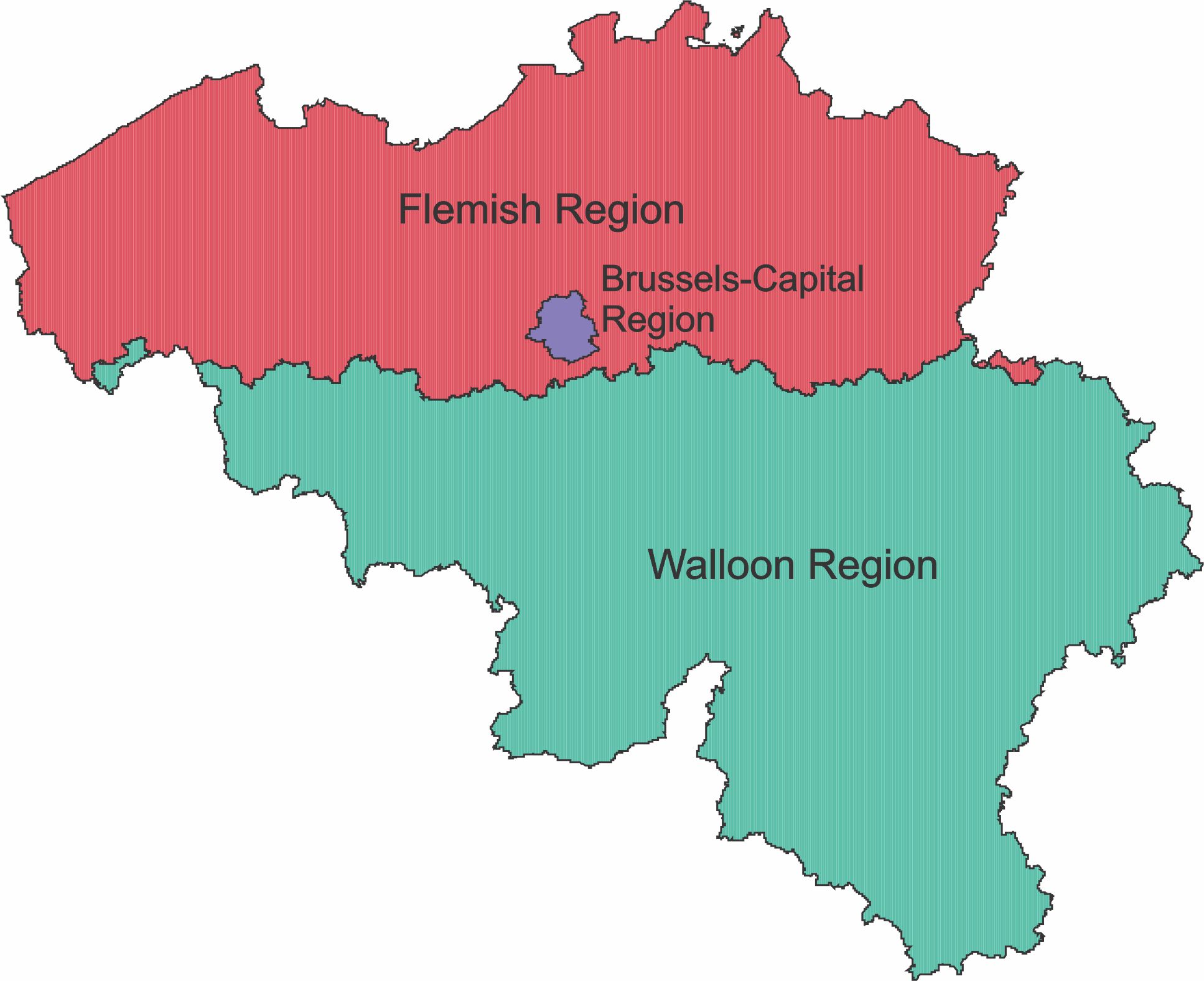 The Brussels-Capital Region in present-day Belgium.
Cartography: Royal Belgian Geographical Society (Société Royale Belge de Géographie)
The Brussels morphological area
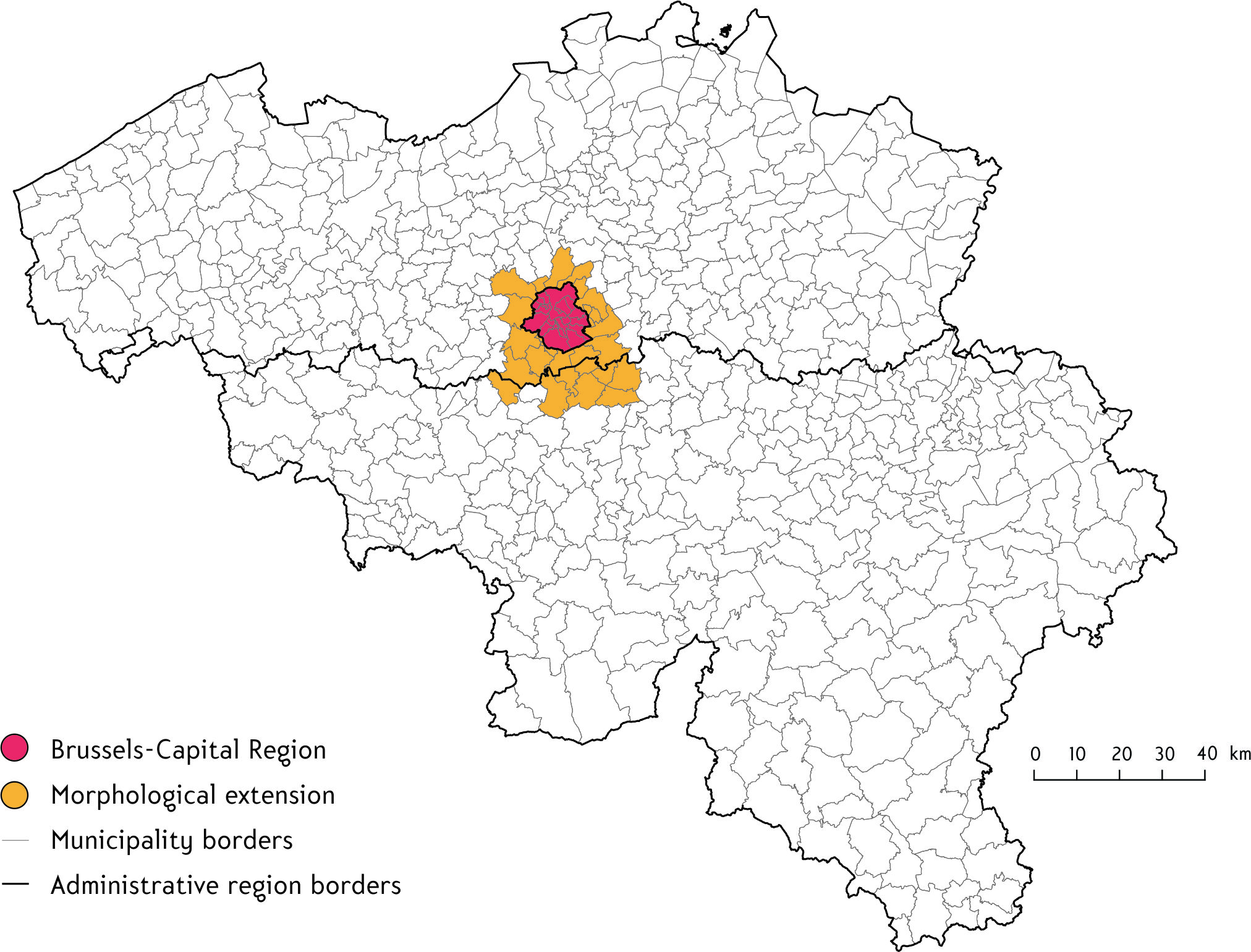 The Brussels-Capital Region and the highly urbanised municipalities (650 inhabitants/km²) of its morphological area. Cartography: Royal Belgian Geographical Society (Société Royale Belge de Géographie)
The Brussels morphological area includes the municipalities close to the Brussels-Capital Region that have a population density of over 650 inhabitants/km² (excluding, of course, the areas covered by the airport and the Sonian Forest). It thus represents a "physical" extension of Brussels well beyond the 161 km² of the Brussels-Capital Region, with the surface area of this vast urban ensemble covering 819 km². The morphological area encompasses a ring of municipalities that surround the Region. It extends along the Canal from Vilvoorde in the north to Tubize in the south, and stretches south-eastwards into the territory of Walloon Brabant, as far as Braine-l'Alleud and Ottignies-Louvain-la-Neuve.
Unlike the Brussels-Capital Region, the "morphological Brussels", which has a population of around 1,800,000, forms a whole without any common administrative or political structure.
The employment catchment area of Brussels
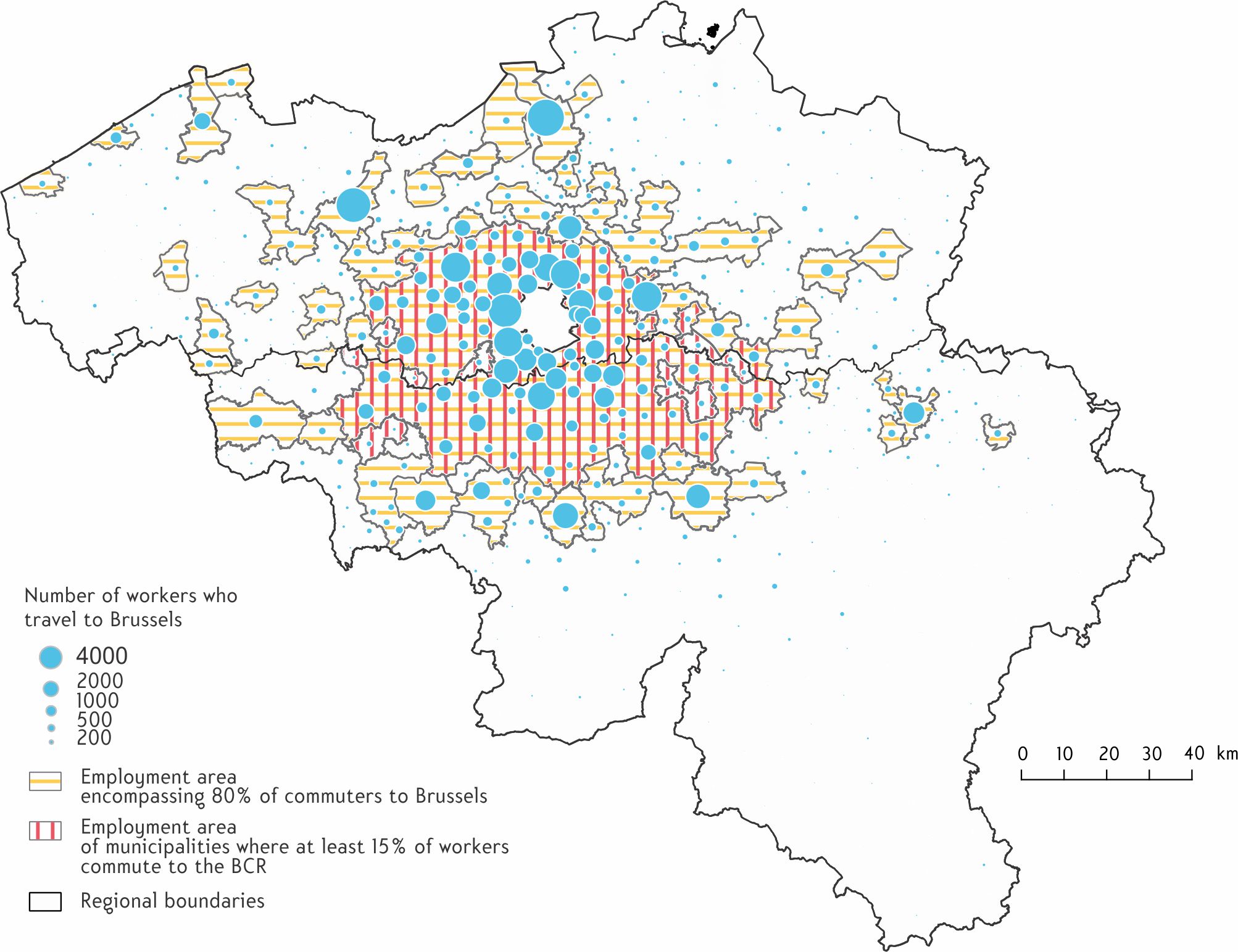 Number of workers commuting to Brussels and the degree of dependence of municipalities on the Brussels employment centre. Cartography: Royal Belgian Geographical Society (Société Royale Belge de Géographie)
The employment catchement covers an even wider area. It can be defined as the set of contiguous municipalities where more than 15% of resident workers are employed in the central employment core (i.e. the Brussels-Capital Region and its adjacent municipalities of Vilvoorde, Machelen, Zaventem and Drogenbos). This employment catchment area (the vertical hatching in the figure) covers the entire former province of Brabant, with the exception of the north-east (where Leuven has an employment centre strong enough to counteract the Brussels influence). To the west, it encompasses the Dender valley in East Flanders, while reaching as far as the north-east of Hainaut, the north of Namur and the first municipalities of the province of Liège in the east.
The "employment catchment area" can also be defined more broadly, such as the set of municipalities that comprise 80% of all workers who commute to Brussels (the horizontal hatching in the figure). This definition encompasses a much larger area, incorporating other Belgian cities which are the points of origin of significant commuting flows to Brussels.
Therefore, as you can see, the "Brussels employment catchment area" represents a different definition of the greater Brussels metropolitan area; one that extends far beyond the morphological realm mentioned above.
Do you have a suggestion, comment or remark about this activity? Click here!