Activity 7: Brussels' new pedestrian area

Brussels, a permanent construction site?
Activity 7: Brussels' new pedestrian area
In order to understand the stakes of the new pedestrian area in terms of reducing car traffic in the city centre, the appropriation of public space by inhabitants, as well as the reactions of residents and shopkeepers, let us examine the realisation of this extensive project.
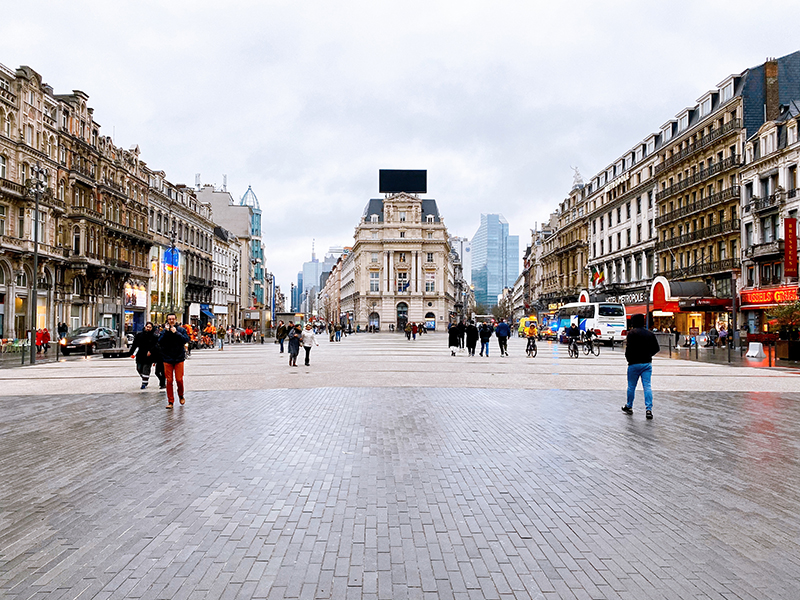
The new pedestrian area, view of the De Brouckère Square. © ULB, 2020.
Envisaged at the end of the 1990s, announced in 2012 and effective since 29 June 2015, the pedestrianisation of the central boulevards (built in the 19th century following the covering of the Senne) from De Brouckère Square to Place Fontainas / Fontainasplein, is one of the most symbolic construction projects of recent years. It has profoundly transformed the city centre of Brussels from a realm dominated by cars into a space for pedestrians and soft mobility. The project's objective is to improve the quality of life, the health of residents and their social cohesion, while creating a convivial zone that attracts a large number of Brussels residents, as well as tourists.
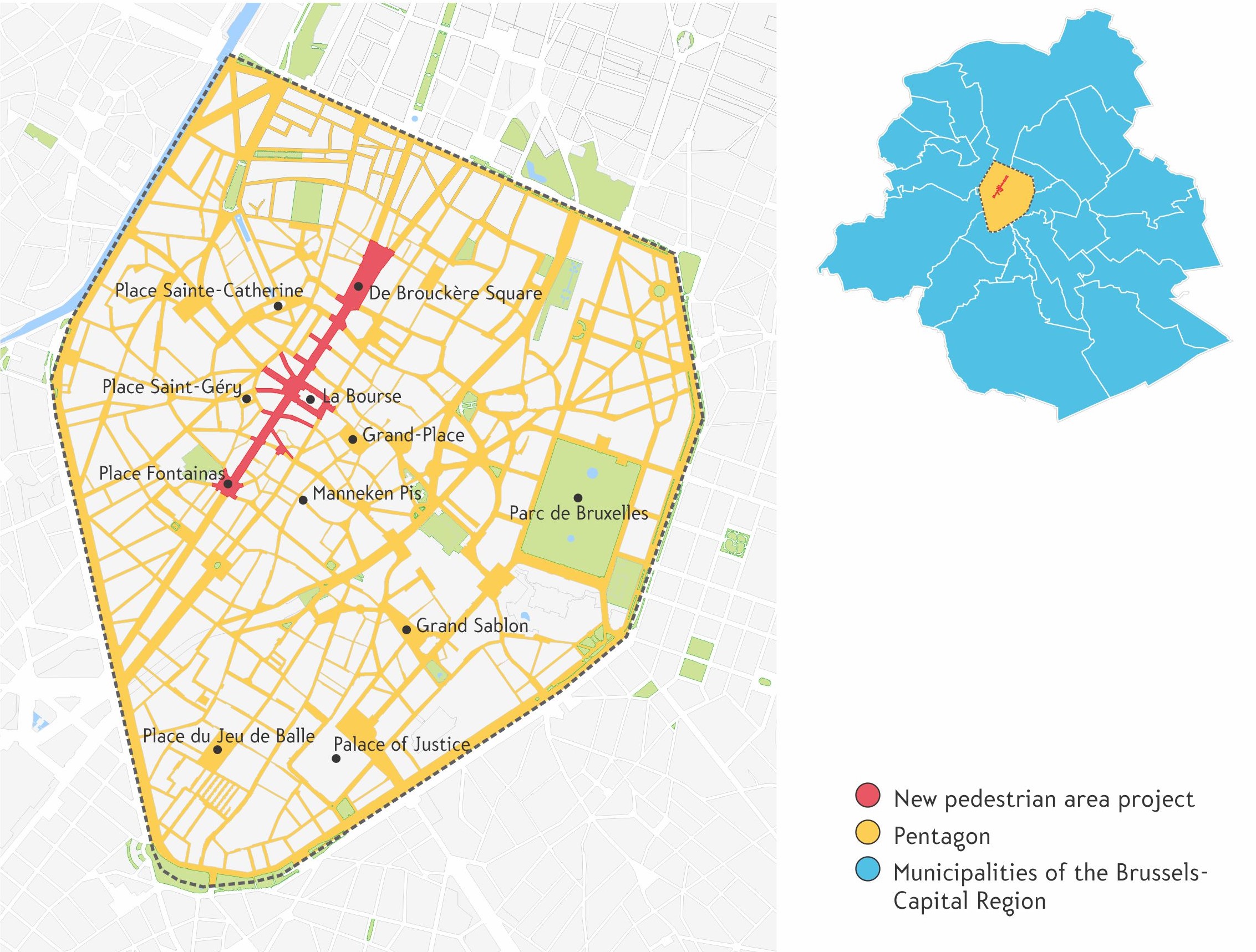
Plan of the new pedestrian area in the centre of Brussels (March 2019). Source: UrbiS base map, derived from a map of the City of Brussels.
This new pedestrianisation project only materialised in 2012, after a political compromise within the political majority of the City of Brussels. It included the construction of four new car parks (a project that was eventually abandoned) and a reorganisation of traffic in the adjacent streets. The initial objective was to ensure accessibility by car for visitors and residents who used them out of habit or necessity, while compensating for the elimination of parking spaces within the pedestrianised zone.
This compromise certainly caused a lot of controversy, with the announced development of four new car parks being perceived by some as contradictory to the strategy of reducing car traffic in the city centre. Moreover, the reorganisation of traffic around the pedestrian area was critically labelled as the "mini-ring", which testified to the fear that car traffic and its nuisance would be shifted to the neighbourhoods around the pedestrian zone. Fears were also expressed about the simultaneous presence of a discourse flaunting "a city shaped for its inhabitants" as well as declarations marked by logics of economic attractiveness. This includes the likes of turning the De Brouckère Square into a "Times Square", making the new pedestrian area a "Belgian Avenue" or a zone for "Family Pleasure Shopping", and transforming the Bourse into a "Beer Temple".
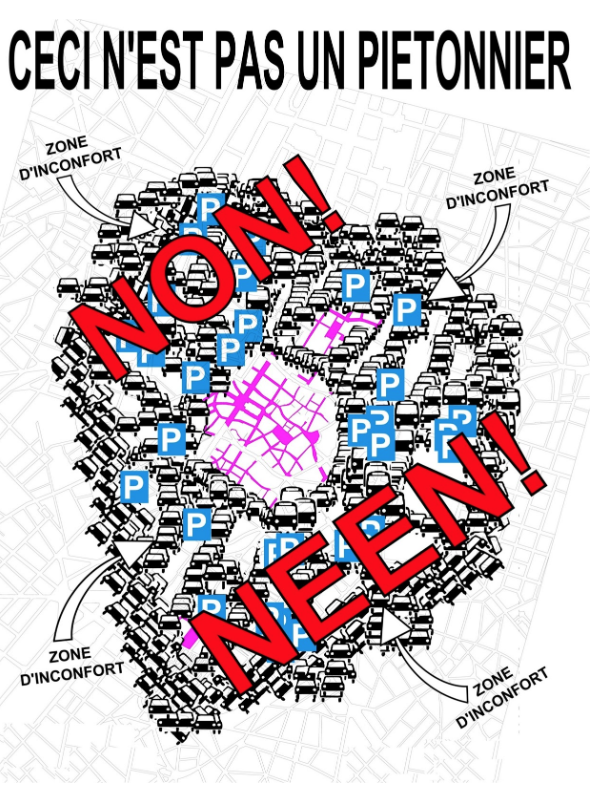
"Ths is not a pedestrian area" Source: Platform Pentagone
In the following video, you will hear the analyses of the socially engaged philosopher Philippe Van Parijs (UCLouvain) and the architect Pierre Vanderstraeten (UCLouvain).
These excerpts are taken from a Massive Open Online Course of EPFL (École polytechnique fédérale de Lausanne).
Do you have a suggestion, comment or remark about this activity? Click here!