
Activity 8: From the Canal to the Kanal

Brussels, a permanent construction site?
Activity 8: From the Canal to the Kanal
As you have seen in activity 2 of this section, Brussels' location at the intersection of waterways and land routes enabled it to rapidly develop commercial activities. The first transhipment point for goods between the road and the Senne was established not far from the present-day Place Sainte-Catherine / Sint-Katelijneplein. The ensuing economic development of the town, sequentially dominated by drapery, tapestry, lace and then the intensification of trade, prompted the city authorities to dig a canal with a different course from the Senne. This would become the Willebroeck Canal, completed in 1561, which provided a waterway connection between Brussels and Antwerp.
The Industrial Revolution led to the development of new industries in the capital, such as earthenware, printing and coachwork. Commercial activity intensified and the supply of raw materials such as coal to the city became an economic priority. It was in this context that, in 1827, the construction of a canal linking Brussels to the mining region of Charleroi began, leading to its inauguration in 1832. Meanwhile, the depth of the Willebroeck canal was increased to 3.2 metres in order to accommodate larger ships. The presence of the two canals, which crossed at Place de l'Yser / Ijzerplein, fostered the industrial development of Brussels, which, as you saw in section 4, would become the country's leading industrial city.
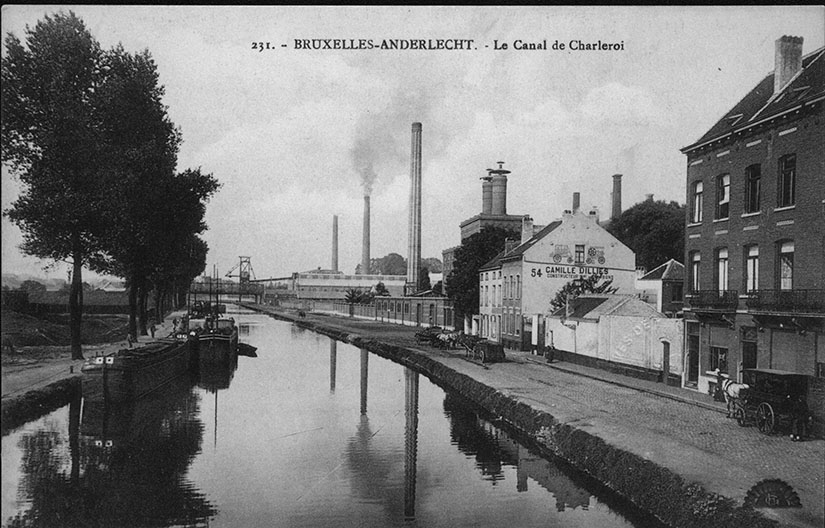
The Charleroi Canal, circa 1910. © Collection Guides Badeaux.
At the end of the 19th century, the economic growth of Brussels necessitated the reorganisation of the waterway transport system and the construction of a real maritime port. This was finally inaugurated in 1922 and consisted of three large docks: Gobert, Béco and Vergote. To facilitate the direct connection with the Charleroi Canal, the bed of the Willebroeck Canal was also moved 60 metres to the west. The two canals were henceforth linked under the bridge at Place Saincletette / Saincteletteplaats. Thanks to these transformations, Brussels now ensured a direct link between the Scheldt estuary and the Hainaut region. It was in this context that the Tour & Taxis complex was built, which combined a commodity station directly linked to the canal, with a customs area.
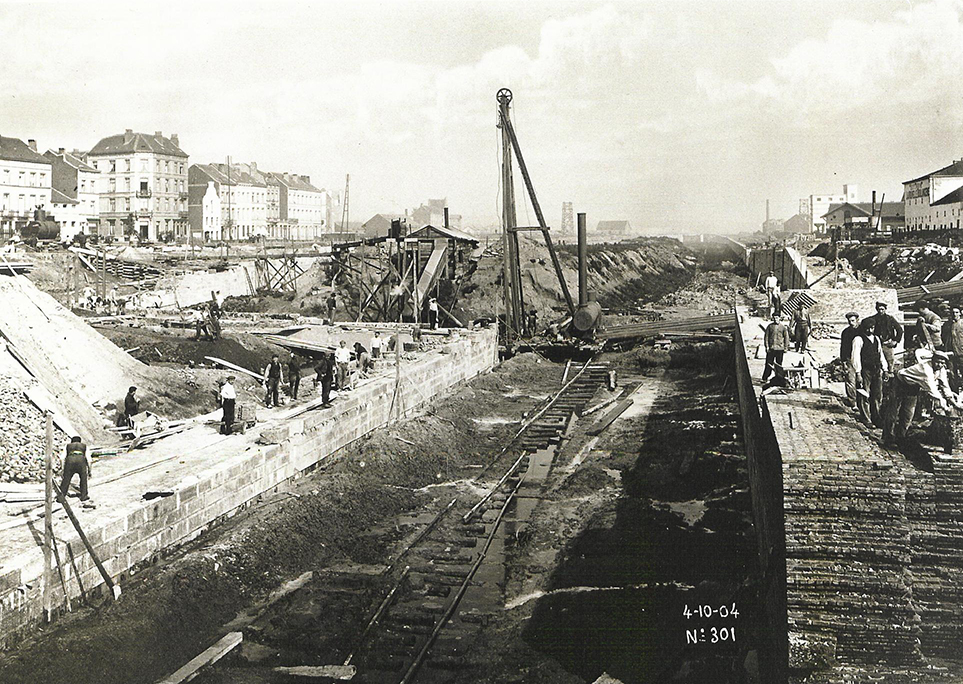
The construction of the Béco Dock and a channel for the realisation of the maritime port of Brussels (1904). © Collection Guides Badeaux.
An increasing number of industries chose to settle along the canal, particularly in Molenbeek, which was nicknamed "'little Belgian Manchester".
In the second half of the 20th century, however, the process of de-industrialisation of the capital led to the closure of many industrial plants in the canal zone. This led to an increase in unemployment, the departure of a number of inhabitants and the dilapidation of many buildings that had become derelict.
This evolution prompted a series of cultural actors to progressively invest in this territory, where they benefited from exceptional venues available to them at low cost, as well as the proactive involvement of the Flemish Community authorities in favour of Dutch-speaking cultural initiatives. Over time, renovations and temporary occupations have led to a proliferation of cultural venues that have become "institutionalised". Museums, theatres, concert halls and nightclubs have all contributed to making the canal's banks a hotspot of Brussels' cultural life, even forming part of its "underground" scene.
In the following video, you can get an idea of the atmosphere of some iconic cultural places in the canal zone:
This movement has been reinforced by the growth in popularity of discourses presenting culture as a factor of urban development and international attractivity. In this context, the construction of the Guggenheim Museum in the Spanish city of Bilbao has often been used as a reference. The museum is said to have revitalised the Basque city, which had fallen into an economic slump following its deindustrialisation.
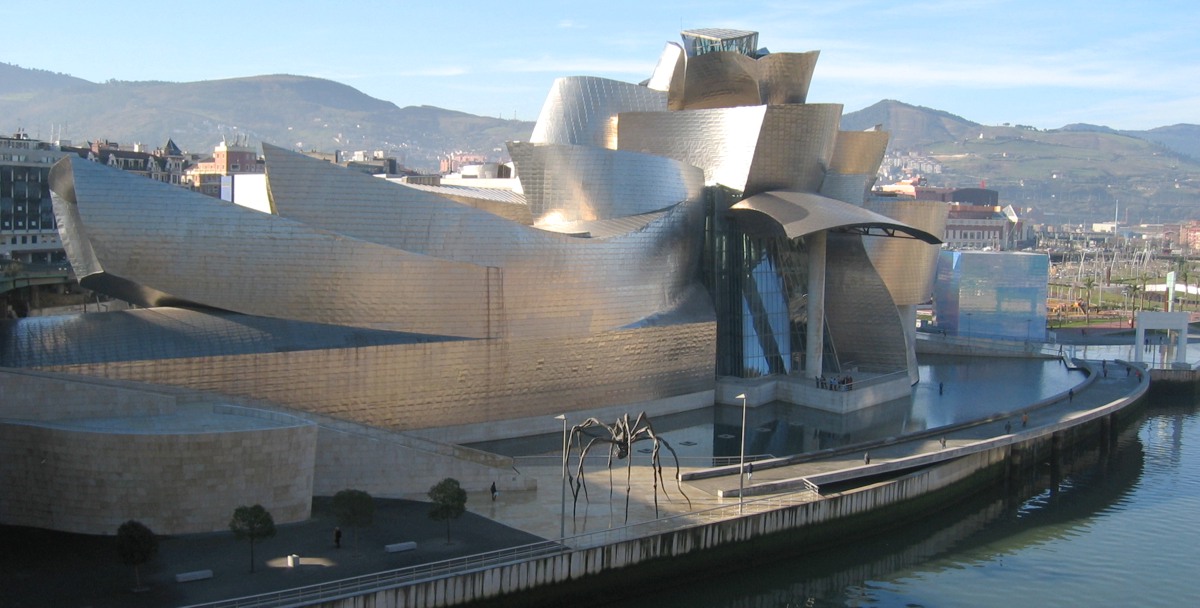
The Guggenheim Museum in Bilbao, inaugurated in 1997. © MykReeve, CC BY-SA 3.0.
Since the beginning of the 2000s, the Brussels-Capital Region, supported by the federal and Community authorities, has launched several programmes for the socio-economic revitalisation of the districts near the canal. These have enabled the development of new teaching and training opportunities, local economic initiatives and housing infrastructures, all in response to the challenges of unemployment and demographic growth. A number of urban development projects have thus been realised near the canal, including the construction of medium to high-rise residential towers.
At the same time, the government has supported various initiatives to foster the development of new cultural infrastructures of local, regional or international importance. This policy is based on the premise that a thriving cultural and creative economy will have a positive effect on the quality of life and social cohesion.
Following this logic, the Urban Development Corporation of the Brussels-Capital Region (SAU-MSI) acquired the former Citroën garage at Place de l'Yser / Ijzerplein in 2015, with the aim of developing a cultural pole of international standing. The Kanal Centre Pompidou contemporary art institution was opened in May 2018 for one year, foreshadowing the reopening of the museum in its definitive form, scheduled for late 2022/early 2023.
In the following map you can discover some of the projects developed in the vicinity of the Brussels Canal.
Do you have a suggestion, comment or remark about this activity? Click here!


©