Activity 2: Immigration to Brussels from the independence of Belgium until the 1960s

Brussels, the second most cosmopolitan city in the world?
Activity 2: Immigration to Brussels from the independence of Belgium until the 1960s
In 1830, when Belgium became independent, Brussels had approximately 115,000 inhabitants, slightly more than Ghent (87,000) or Antwerp (74,000). The presence on its territory of the institutions of the new Belgian state, the concentration of the national bourgeoisie, its position at the heart of the road (and soon rail) network, but also the growing presence of industries contributed to the rapid expansion of the Brussels population.
The Brussels population has been growing almost uninterrupted until today, as you can see on this graph. By clicking on the "+", you will better understand the context of this demographic evolution.
Evolution of the number of inhabitants in the Brussels morphological area (and within the current boundaries of the Brussels-Capital Region)
Source: VANDERMOTTEN, Christian, Bruxelles, une lecture de la ville. Bruxelles, 2015, p. 80.
The contribution of immigration to population growth in Brussels
During the 19th and 20th centuries, the economic growth of Brussels and the growth of its industrial activity (for more information on this subject see section 4), fuelled by the rural exodus, led to the arrival of workers from Flanders and Wallonia. They mainly settled in the industrial area in the west of the city. At the same time, during the 19th century, Brussels welcomed (specialised) workers from abroad and many refugees from Germany, France and Poland. Among the most famous political refugees were Victor Hugo and Karl Marx.
As you can see in the table below, it is from the 1960s onwards that immigration made a significant contribution to the growth of the Brussels population.
Belgian and foreign residents in the Brussels-Capital Region (1846-1970)
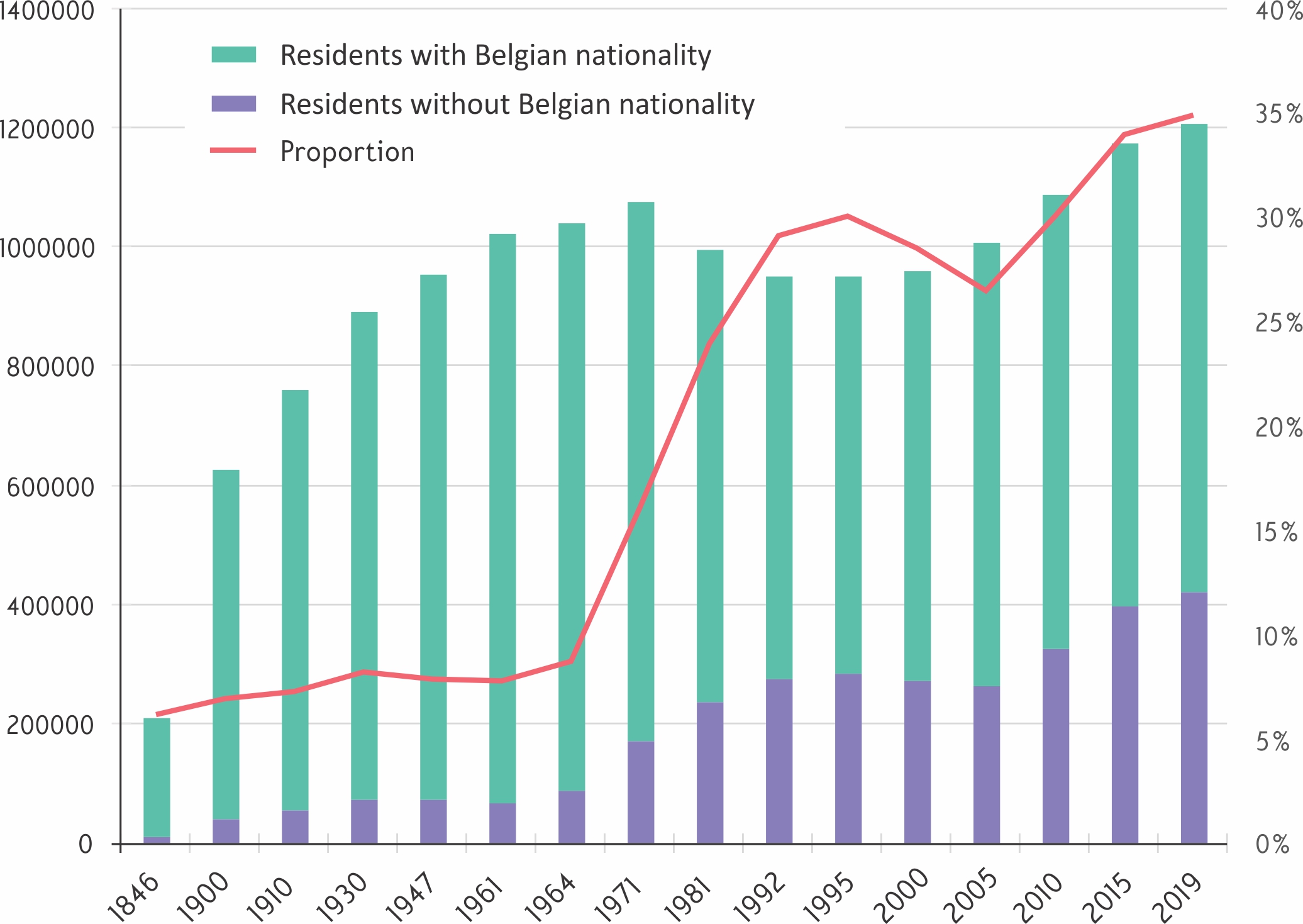 Figures from 1846 to 1991: VAN DER HAEGEN H., JUCHTMANS G., KESTELOOT C. (1995). Multicultureel Brussel, Brussels Hoofdstedelijk Gewest, Brussel. From 1992 onwards, figures from StatBel, disponibles en ligne.
Remark about this graph: always be careful with the "nationality" indicator as it does not represent migration movements accurately. Indeed, immigrants who settle in Belgium (and their children) can acquire Belgian nationality under certain conditions. Therefore, nationality, unlike the place of birth of individuals or of their (grand)parents, only very imperfectly reflects the diversity of a population.
Immigration after 1945
After the end of the Second World War, the Belgian state was in demand for labour, particularly for the exploitation of mines in Wallonia. It first concluded various bilateral agreements to receive workers from European countries. As you will see on the map, the first bilateral agreement was signed with Italy in 1946. Other agreements were signed in the following years with Spain (1956) and Greece (1957). We will refer to them as "guest workers".
Belgium's bilateral agreements to receive foreign workers
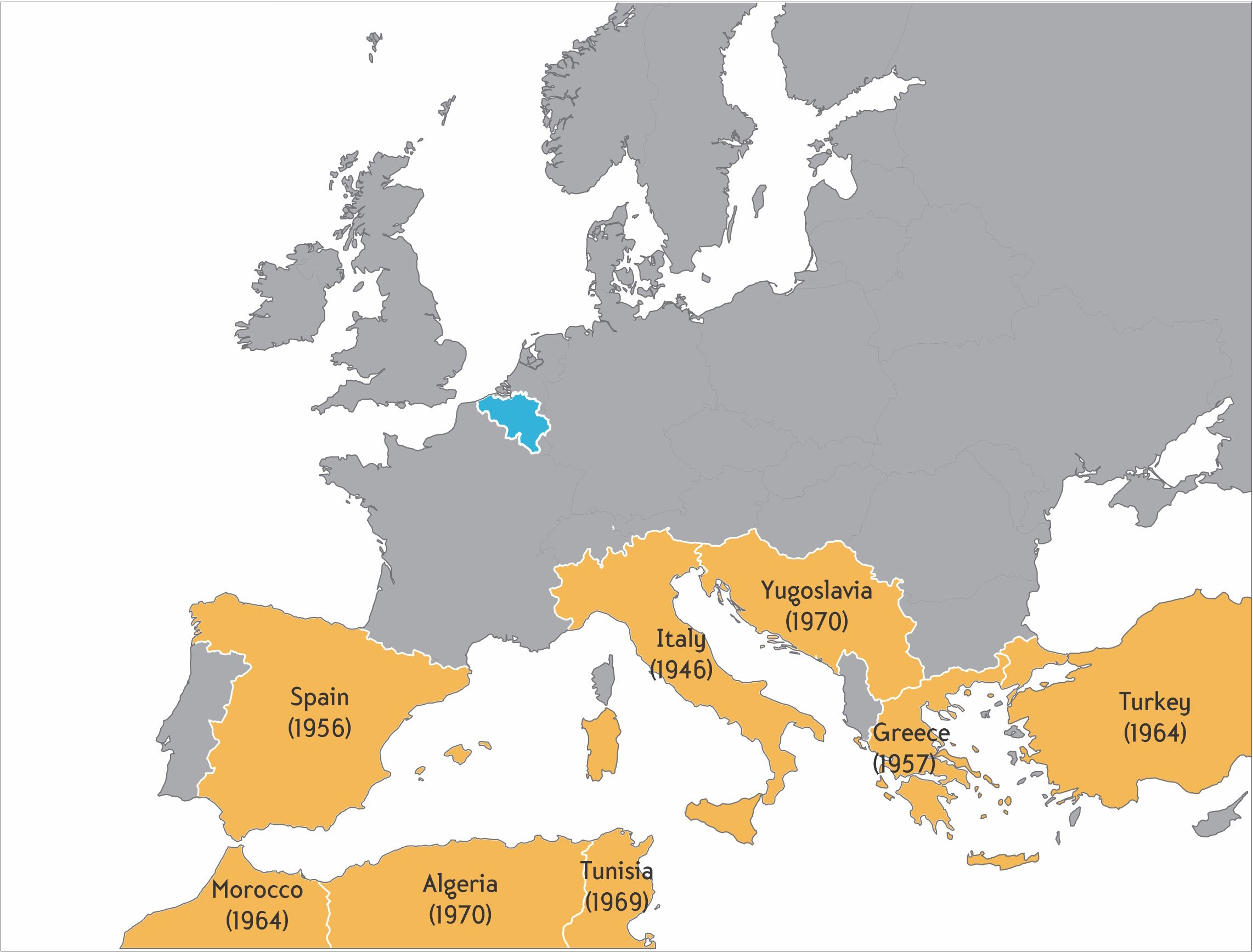 Countries with which Belgium concluded bilateral agreements to receive foreign workers.
Cartography: Royal Belgian Geographical Society (SRBG)
Following the economic growth of the 1960s, the Belgian State concluded new bilateral agreements to attract low-skilled foreign workers: with Morocco and Turkey in 1964, then with Tunisia in 1969 and Algeria in 1970. At the same time, international organisations that chose to locate in Brussels attracted a growing number of professional and managerial staff and senior civil servants. Highly qualified foreign workers were therefore recruited by European institutions (starting in 1957), NATO (starting in 1966) and a series of other international organisations or NGOs. At the same time, peri-urbanisation was increasing, as you already saw in the first graph: the middle classes left the city to settle in its periphery.
All this led to a strong diversification of the Brussels population. Until the 1960s, the proportion of foreign residents in the entire territory of what would later form the Brussels-Capital Region had always remained below 10% (as you can see in the graph above), although there were major differences from one district to another.
From 1967 onwards, the free movement of workers within the European Economic Community (EEC) intensified the flow of European nationals going to Brussels. A clearer division emerged between two main 'categories' of immigrants with different rights: those coming from an EEC member country (and later from the European Union) and those coming from other countries.
Only Europeans will benefit from an increasing number of measures aimed at promoting equal treatment with Belgian nationals (such as the phasing out of visas and work permits). The others, whose rights are much more limited, fall into three sub-categories:
|
1
|
People with a residence permit of unlimited duration; |
|
2
|
Pleople with a temporary residence permit; |
|
3
|
People without a residence permit and who, as a result, escape most official statistics. |
In the following table, you will find a simplified summary of the main differences between the groups that make up the Brussels population.
The notion of "categories" of citizens applied to the Brussels Capital Region of today
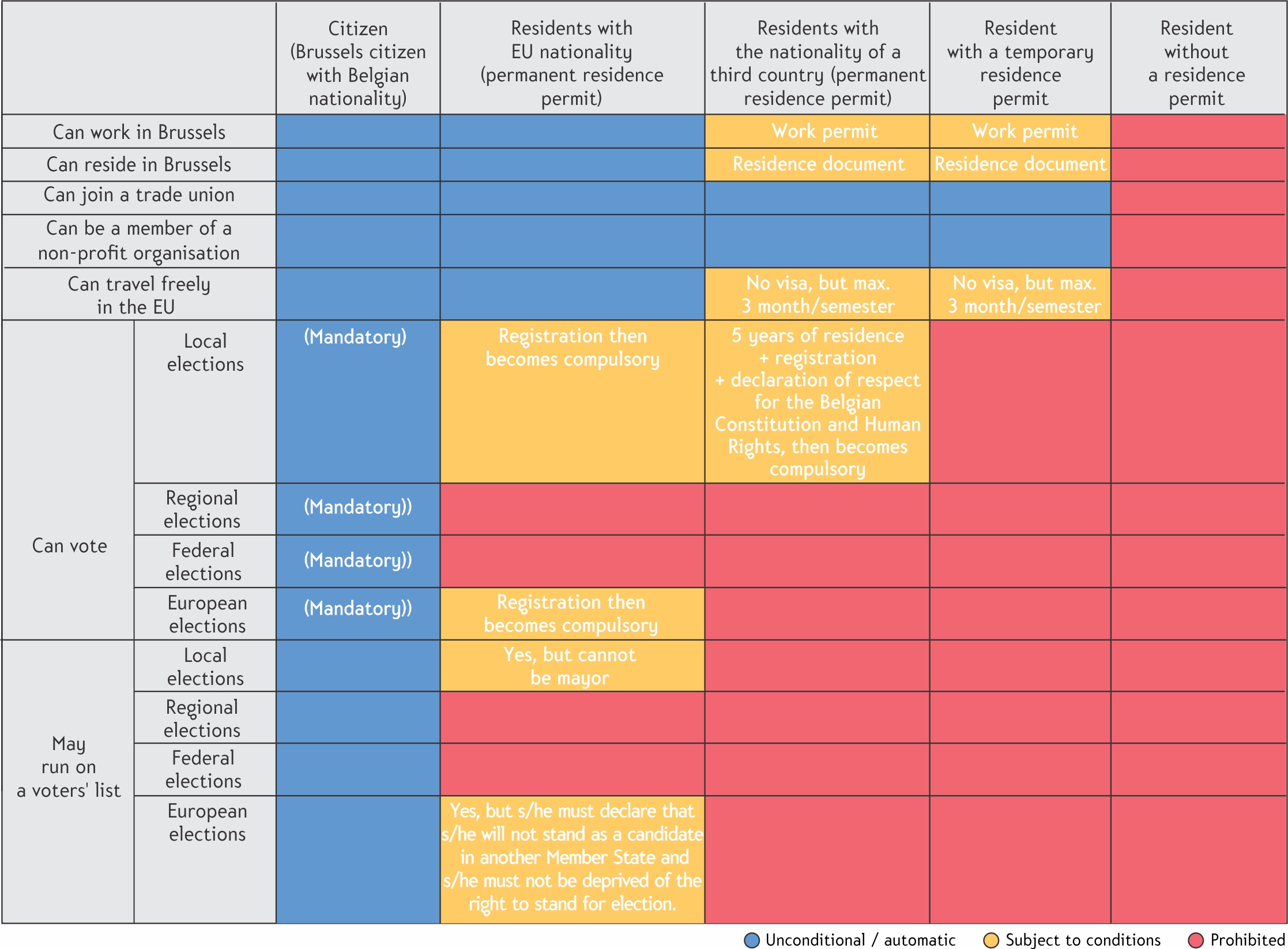 This table has been created on the basis of the 'concentric circles of citizenship in European states' presented in Rea A., "Les immigrés et la citoyenneté de l'Union européenne. Les effets de clôture du traité de Maastricht et le déplacement des discriminations", in Telo M. et Magnette P. (Eds), Repenser l'Europe, Bruxelles, Editions of the Université de Bruxelles, 1996, pp. 85-101.
In the following exercise, you will find descriptions of concrete cases based on the table above. Choose whether you think the statement is true or false.
Foreign resident, political refugee, immigrant... It is high time we clarify the meaning of these terms, which are widely used in this section and which you hear daily on the news. To help you, here are a few important points of reference:
Some vocabulary references
Foreigners
According to the National Register, which publishes official statistics in Belgium, a foreigner is a person who does not have Belgian nationality. Therefore, people with dual nationality (e.g. Belgo-Moroccans) are not considered as foreigners in Belgian statistics.
In Belgium, a foreigner whose residence visa is in order (citizens of a number of countries - particularly those that are members of the European Union - are exempt) can stay in the country as a "tourist" for up to three months. After this period, they must register with the municipal administration of their place of residence. Foreigners staying in Belgium for less than three months are therefore not included in national statistics, just like undocumented migrants and diplomats.
On the other hand, European civil servants are taken into account in the population size of the National Register.
Nationality
You have just seen that people with dual nationality are not considered as "foreigners" by the National Register. But what about, for example, those who had a Dutch nationality and lost it when they became Belgians (the Netherlands do not accept dual nationality)?
The statistics here differentiate between nationality at birth and current nationality. Note that in this section we always refer to current nationality unless we explicitly state otherwise.
People of foreign origin
You have probably also heard of "people of foreign origin". This is actually a concept which, this time, no longer takes into account a person's place of residence or legal status, but rather their origins (their ancestors), sometimes referred to as their 'ethnicity'. The inclusion of these people in national statistics is subject to much debate. Some countries consider a person to be of foreign origin when at least one parent or grandparent was born abroad, or even when the person simply states that he or she has foreign-born ancestors. In Belgium, the state has no official right to collect data on the ethnic origin of its population (nor on their political opinions, religion or language use). However, some official monitoring does include data on ethnic origins, such as the FPS Employment in its analysis of workers in the labour market. Ethnic statistics are of course a very sensitive topic on the Belgian political scene.
You will also notice that there are other statuses that are not included here, such as that of a refugee (a person recognised by a State that has ratified the Geneva Convention and who meets the criteria defined by that Convention to benefit from the protection of that State) or that of a foreign student.
In conclusion, the nuances between each term are of great importance as they provide many clues as to one' s country of origin, family situation, social position, place of birth, etc.Do you have a suggestion, comment or remark about this activity? Click here!