Activity 8 : Language diversity in Brussels

Brussels, the second most cosmopolitan city in the world?
Activity 8: Language diversity in Brussels
Although from a political point of view, Brussels is currently officially a bilingual region (see section 1: Brussels, capital of what?), the sociolinguistic reality has been much more diverse the past few decades.
The different migratory waves referred in previous sections have helped to diversify the number of languages spoken in Brussels. For example, non-Belgian Brussels citizens made up 34.8% of the total population of the Brussels-Capital Region in 2018. If we add to this percentage the people of foreign origin who have obtained Belgian nationality in recent decades, we arrive at 57.13%, i.e. well over half of the Brussels population.
In this context, defining the linguistic identity of the inhabitants of Brussels has become a particularly complex task, especially since official language censuses are no longer available. Fortunately, since the end of the 1990s, researchers have regularly been sending out questionnaires to a representative sample of the Brussels population to find out their languages proficiency, enabling us to monitor changes more closely.
It emerges from these findings that, alongside French, which (according to the interviewees) remains by far their most spoken language, there are now more than 100 languages spoken in Brussels. However, the surveys particularly point to a strong and interesting increase in multilingualism over the last few years. For example, the proportion of people who say they grew up in a monolingual French-speaking family lies now between 34 and 55%. In other words, a significant proportion of the inhabitants of Brussels are bilingual, multilingual or even 'allophone'.
In the graph below, you can see in yellow which languages are commonly spoken by the inhabitants of Brussels and in red those commonly spoken by the inhabitants of the Flemish periphery. You can observe that few people in Brussels speak Dutch, while many residents in the Flemish periphery are fluent in French.
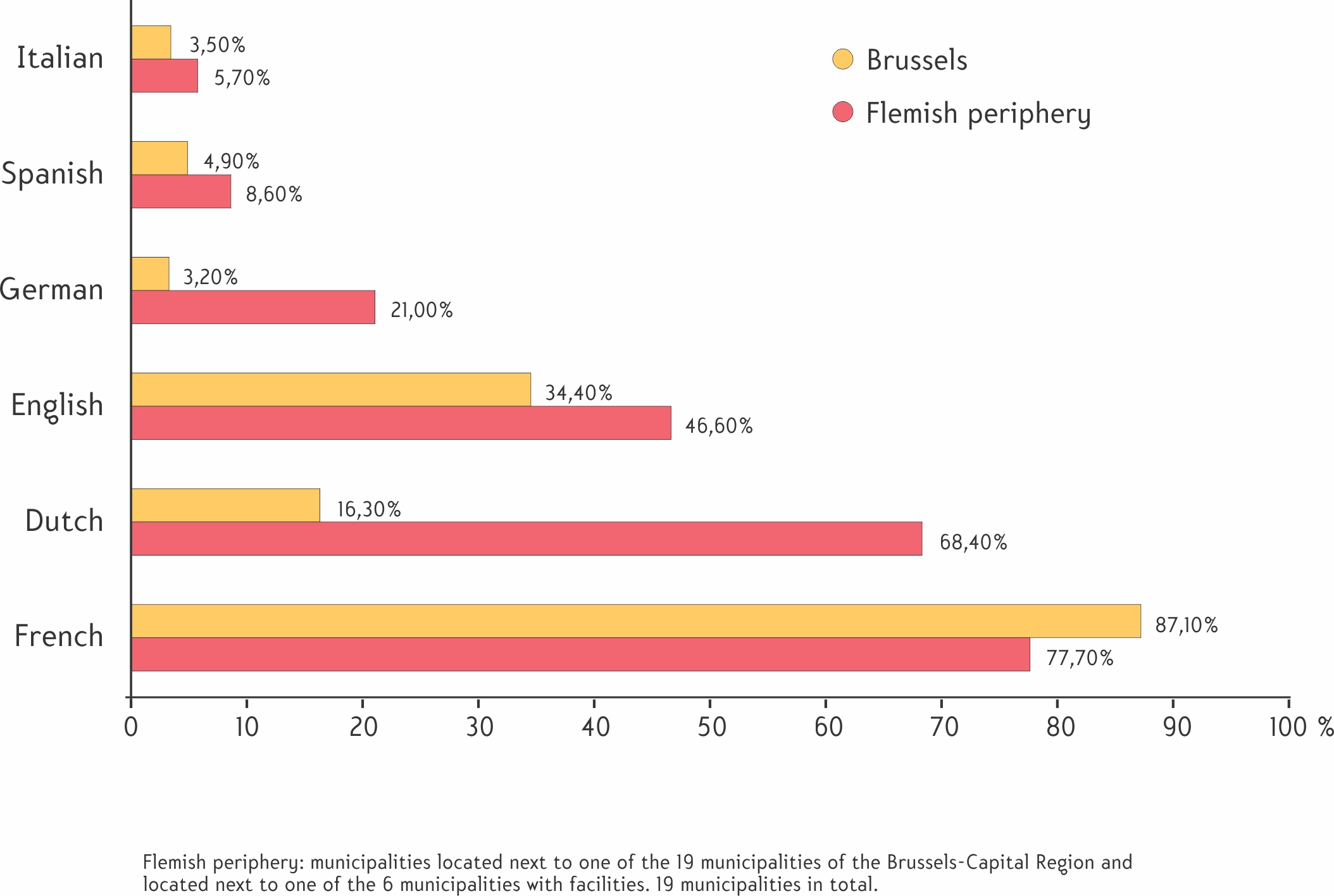 Percentage of residents in Brussels and the Flemish periphery who are fluent in the languages cited above. The Flemish periphery is made up of the municipalities located on the territory of the Flemish Region where the official language is Dutch, i.e. Asse, Beersel, Dilbeek, Drogenbos, Grimbergen, Hoeilaert, Kraainem, Linkebeek, Machelen, Meise, Merchtem, Overijse, Rhode-Saint-Genèse/Sint-Genesius-Rode, Leeuw-Saint-Pierre/Sint-Pieters-Leeuw, Tervueren, Vilvorde/Vilvoorde, Wemmel, Wezembeek-Oppem and Zaventem. Sources: BRIO link 1 and link 2
Using the table below, you can get a better idea of the different languages spoken by the inhabitants of Brussels depending on the activities they are carrying out.
Brussels Language Barometer in 2018
| Language spoken/activity (%) | At home | At work | With friends | In cafés and restaurants | When shopping |
| French | 52,2 | 33,9 | 31,2 | 51,8 | 55,3 |
| Dutch | 5,6 | 0 | 0,2 | 0,2 | 0,2 |
| English | 0 | 0,2 | 0 | 0 | 0 |
| French/ Dutch |
10,7 | 18,1 | 14,5 | 18,8 | 22,3 |
| French/ English |
0 | 20,1 | 12,9 | 10,7 | 8 |
| Dutch/ English |
0 | 0 | 0 | 0 | 0 |
| French/ Dutch/ English |
0 | 28,1 | 15 | 9,4 | 6,6 |
| French/ Arabic |
0 | 0 | 5,4 | 3,4 | 3,6 |
| French/ Other |
10,1 | 0 | 0 | 0 | 0 |
| Other | 21,4 |
Source: Taalbarometer, VUB (Janssens, 2018). Remark: Please note that this aggregated table is not based on the same questions, hence some differences. Sometimes, only the use of the 3 contact languages was queried (as in the "At work" section) and sometimes the question on the use of languages was left open (as in the "With friends" section). The information given above is therefore only intended to indicate that language use may vary depending on the context.
As you can see, people in Brussels use different languages depending on the context. Although French is still the lingua franca, Brussels is characterised by the importance of multilingualism, more so than merely bilingualism.
If you would like to know more about language use in Brussels and the internationalisation of the city, have a look at the articles below from the Brussels Studies Journal:
- Rudi Janssens, "Language use in Brussels and the position of Dutch", Brussels Studies [Online], Collection générale, n° 13, published online on 07 January 2008.
- Jean-Pierre Hermia et Christian Vandermotten, "The world in Brussels, Brussels in the world", Brussels Studies [Online], Fact Sheets, n° 94, published online on 27 November 2015.
The language barometer on Brussels is also a rich source of information on language use in the Brussels Region. This large-scale study was initiated by the sociologist Rudi Janssens in 2001 and was carried out again every 4 to 5 years. You can find more information on this subject on this website.
Do you have a suggestion, comment or remark about this activity? Click here!