Activity 5: The foreign-born population and the labour market in Brussels

Brussels, the second most cosmopolitan city in the world?
Activity 5: The foreign-born population and the Brussels labour market
You saw in the previous activity that according to their socio-professional profiles, the Brussels population of foreign origin tended to settle in well-defined neighbourhoods, reinforcing the social and spatial dualisation between the inhabitants of the "poor crescent" and those of the municipalities in the south-east of the city.
The social impact of discrimination
People living in poor areas of the city are often subjected to discrimination when looking for a rental flat or a job. Several studies have therefore shown that with the same level of education, the chance of finding a job for a Brussels resident living in a poor neighbourhood is slimmer than if they lived in one of the more affluent parts of Brussels.
This is explained in particular by the difficulty in mobilising a social network likely to help them, but also by persisting discrimination in hiring against people of foreign origin. In 2017, UNIA, a public institution fighting for equal opportunities and against discrimination in Belgium, showed in its annual report that ethnic criteria were the first ground of discrimination in the recruitment process.
In Brussels, Actiris (the regional body in charge of employment policy) still reports strong discrimination in hiring: people of African and North African origin have an unemployment rate three times higher than those of Belgian origin, as you can see in the graph below.
Unemployment rates in the Brussels-Capital Region in 2008 and 2014, by ethnic origin
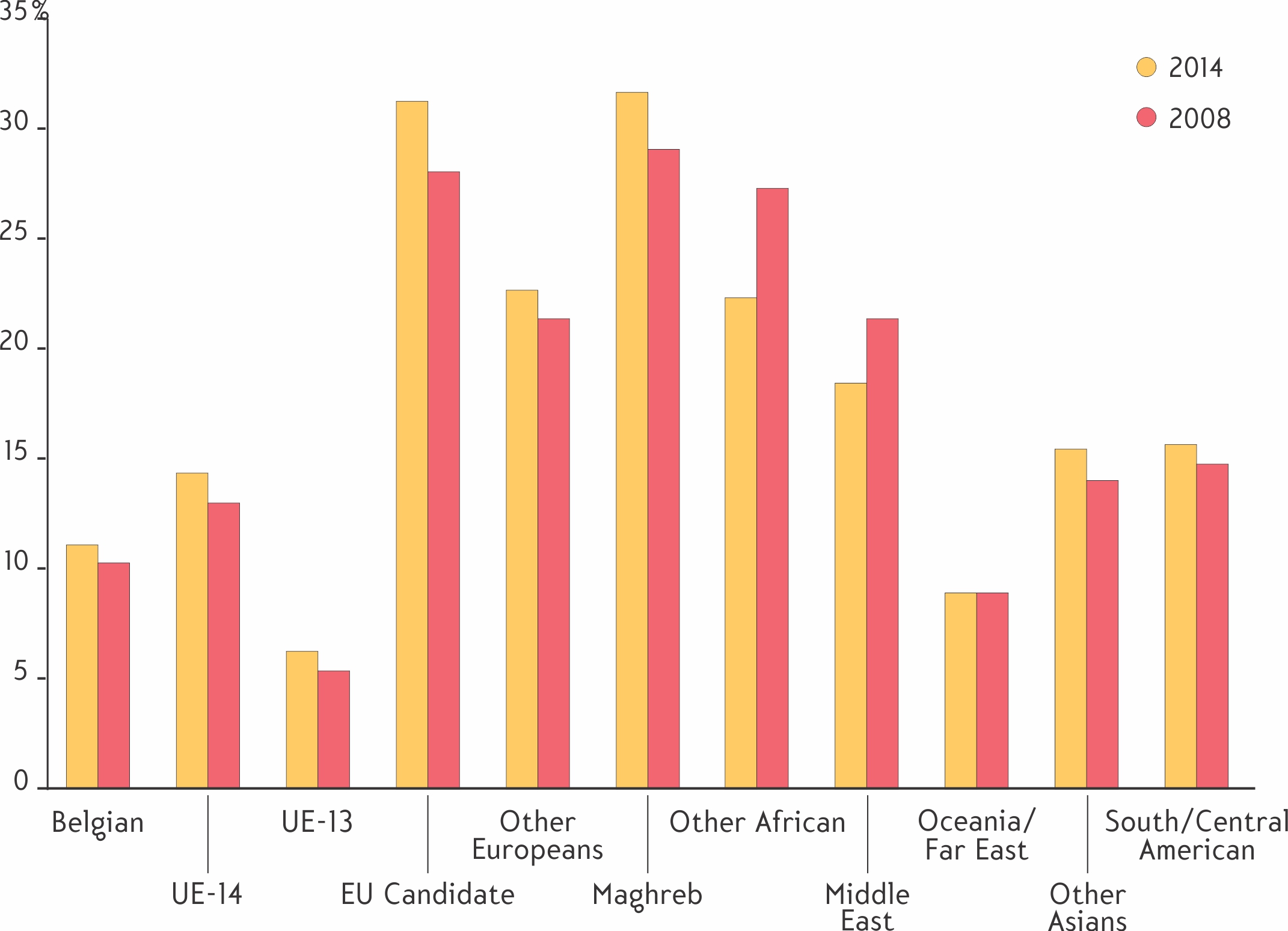 Unemployment rate in the Brussels-Capital Region for people aged 20 to 64, by origin.
© UNIA, "Monitoring socio-économique 2017 : marché du travail et origine". Available online.
In itself, ethnic origin is not the only criterion that explains these unemployment rates. They are also strongly correlated with the level of qualification and with a school system that struggles to compensate for inequalities.
School segregation and the reproduction of inequalities
Young people living in the poor neighbourhoods of Brussels suffer the brunt of social dualisation and the inequalities it creates. This is particularly visible in the education system, where we can speak of actual school segregation.
The PISA (Programme for International Student Assessment) surveys, which analyse students' skills every three years for the OECD (Organisation for Economic Co-operation and Development), show that in Brussels, those with parents or grandparents who were not born in Belgium often have more difficulties at school. They experience a double disadvantage: in addition to the negative effect of belonging to a family that has not been educated in Belgium, they tend to attend a school that will hinder their progress. This is due to certain features of the school system, such as the repetition of a grade and the reorientation towards technical or vocational schools in sections which, contrary to what their name might suggest, are not always the most 'useful' for finding a job in Brussels. It is also observed that among young people who leave school without a diploma, children with a migrant background predominate.
According to some researchers, Brussels education therefore fails to bring its pupils with a migrant background up to the same level of performance as its other pupils, and therefore does not equalise young people's chances on the labour market.
To better understand these notions, we invite you to watch the following video, produced in November 2019, which highlights the main challenges of the school system in the Wallonia-Brussels Federation:
(you can activate English-subtitles by cliquing on  icon, and then by choosing "English" in the parameters)
The above gives you a better understanding of the significant differences in unemployment rates between people of Belgian origin, EU nationals and non-EU immigrants.
To find out more about discrimination, do not hesitate to check the articles by VERHAEGHE P.P., MASTARI L. (2018) as well as Unia's 2017 report, the Actiris' monitoring and Eurostat, from which the figures provided here have been extracted.
Do you have a suggestion, comment or remark about this activity? Click here!