Activity 3: Immigration to Brussels since the 1970s

Brussels, the second most cosmopolitan city in the world?
Activity 3: Immigration to Brussels since the 1970s
The "problem" of immigrants in Brussels
Around the world, periods of crisis or recession are often marked by the closure of borders to foreign workers and accompanied by criticism of non-nationals residing in the country. Belgium is no exception to this observation. As early as 1974, the economic crisis led Belgium to put an end to the bilateral agreements mentioned above. In Brussels, however, the proportion of immigrants continued to increase throughout the 1970s. The closure and restructuring of industrial sites in Wallonia and the Flemish Region led many immigrant workers to seek work in the capital and to settle in the working-class neighbourhoods. Other factors also explain this increase in the proportion of immigrants, such as family reunification measures, a (initially) higher birth rate than in the Belgian population, and the continuing peri-urbanisation, which led an increasing number of Belgian residents to leave the city for the periphery.
But the economic crisis of the 1970s and 1980s led to an increasing number of tensions and conflicts. Immigrant populations who had been invited to Belgium to meet the demand for labour and who had subsequently settled there were strongly criticised by certain extremist groups who considered their presence to be illegitimate. Discriminatory practices and political, institutional or even social racism were developing, with some Brussels municipalities going so far as to refuse to register immigrants in their population register, which was highly controversial.
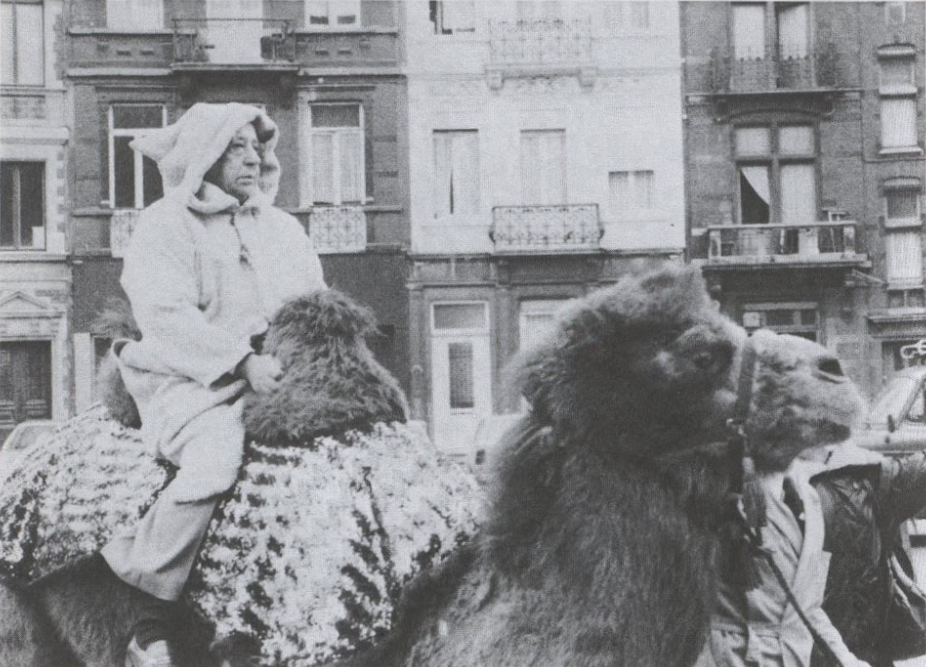
Roger Nols, mayor of Schaerbeek (1970-1989) arriving by camel in front of his town hall. A caricature broadcasted by Belgian television on 31 December 1986 in which the mayor wanted to denounce the consequences, according to him, of granting the right to vote to non-Belgian citizens. © Tractothèque
In the face of this extremism, the Belgian State adopted some timid measures to help the integration of these populations. In 1981, for example, the law against racism and xenophobia was passed. In 1984, the State relaxed the conditions for obtaining the Belgian nationality. Today, a child born in Belgium can obtain Belgian nationality even if his or her parents are foreigners. This is known as the 'right of birthplace', in addition to the 'right of blood'. The Belgian state therefore proceeded with naturalisation by combining both these criteria, which allowed many immigrants to acquire the Belgian nationality (and consequently to obtain the right to vote, which will have an impact on the political life of Brussels). While the effectiveness of these 'integration policies' is sometimes questioned, they do reflect a greater political attention regarding the fight against discrimination and for integration.
Since the fall of the Berlin Wall in 1989
The last decade of the 20th century and the first few years of the 21st century were marked in particular by the consequences of the fall of the Berlin Wall (1989), which facilitated the movement of European populations. The population of Brussels continued to diversify, as can be seen in the following table, where the categories 'Poland' and 'other countries' in Europe show the arrival of people from Eastern Europe and countries of the former USSR.
Nationalities present in the Brussels-Capital Region between 1990 and 2005
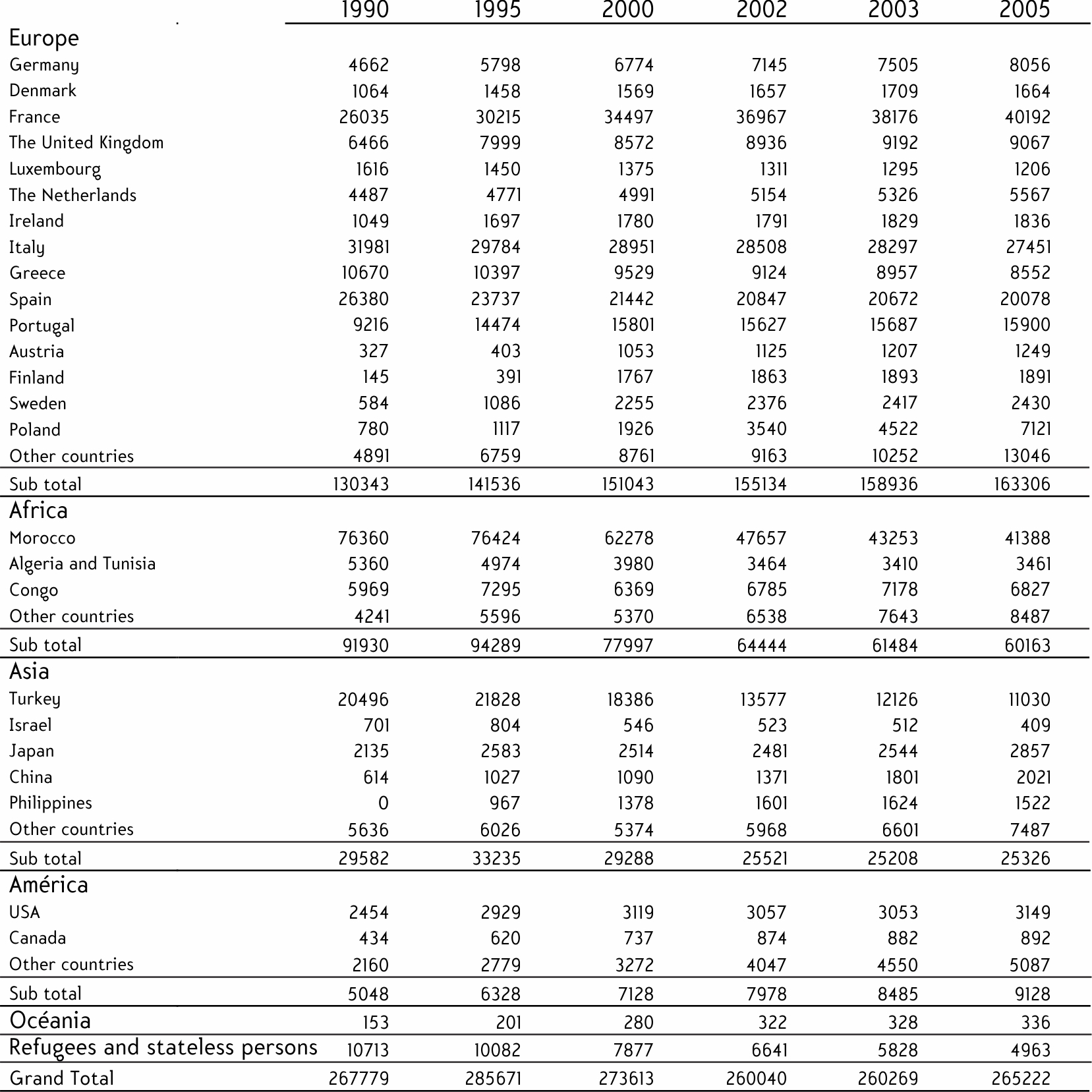 Pol Zimmer, “Les évolutions démographiques et socio-économiques de la Région de Bruxelles-Capitale depuis 1990”, in Courrier hebdomadaire du CRISP, 2007/3 n° 1948-1949, p. 14.
Available online.
Between 2000 and 2018, nationals of the new Member States are increasing most among the EU citizens present in Brussels. In 2018, they will account for almost 85,000 people or 7.2% of the Region's inhabitants, and will in turn play a decisive role in the growth of the Brussels population.
European Union Member States
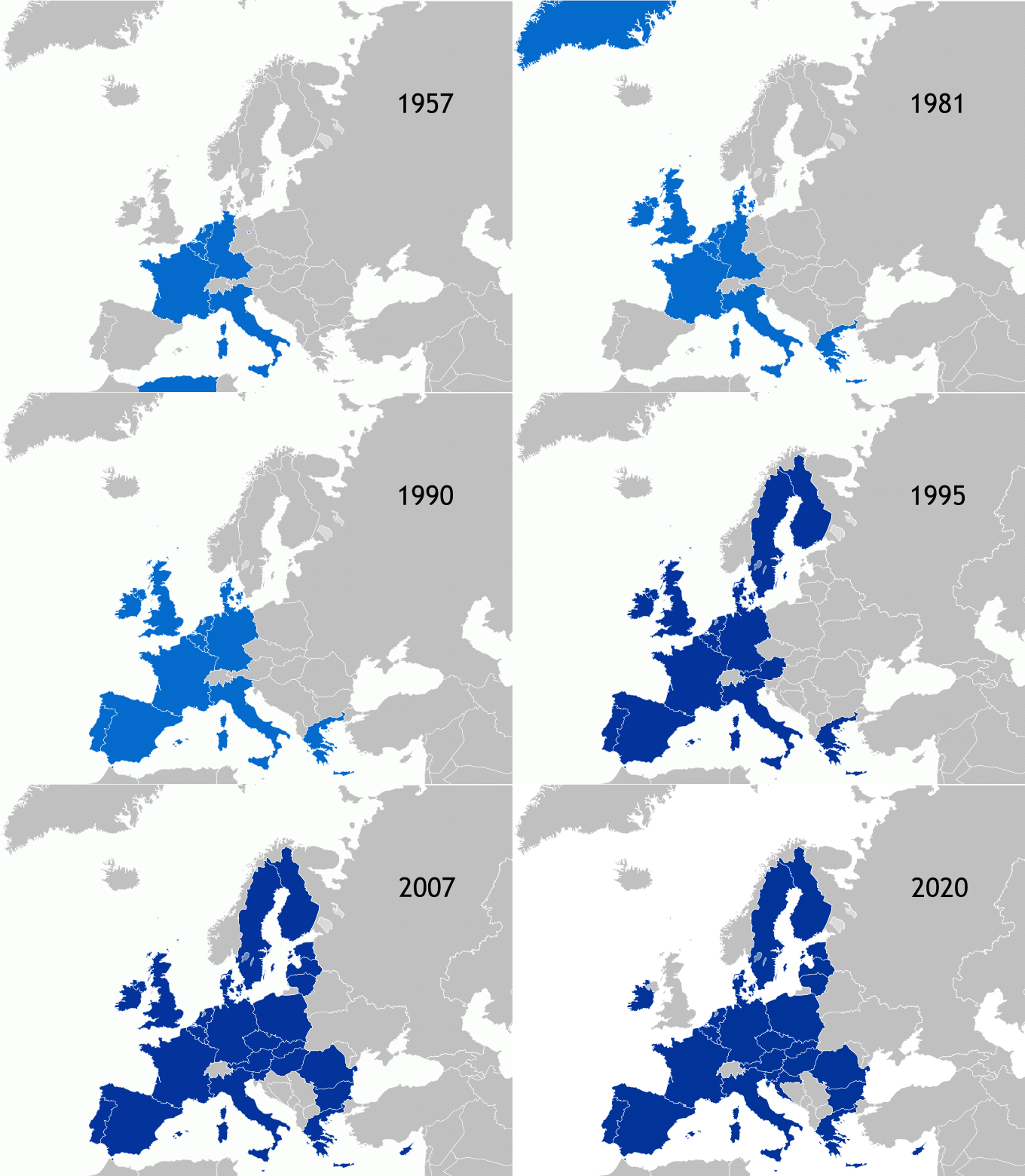
Enlargements of the European Union.
© Kolja21, Public domain.
If you would like to know more about European nationals in Brussels, we invite you to read the following article published in the Brussels Studies Journal in 2019: Charlotte Casier, "The transformation of the demographic structures and geography of Europeans in Brussels between 2000 and 2018".
Finally, it should be noted that at the turn of the 20th and 21st centuries, the above-mentioned groups of migrants were also joined by an increasing number of officially recognised refugees (or people whose application for this status was rejected) as well as other undocumented migrants who did not benefit from the various regularisation cycles. They mainly come from South America, Africa and the Middle East. The table below, for example, illustrates the rapid increase in the number of asylum seekers in the Brussels-Capital Region.
Brussels share of asylum seekers included in the waiting register between 1996 and 2002
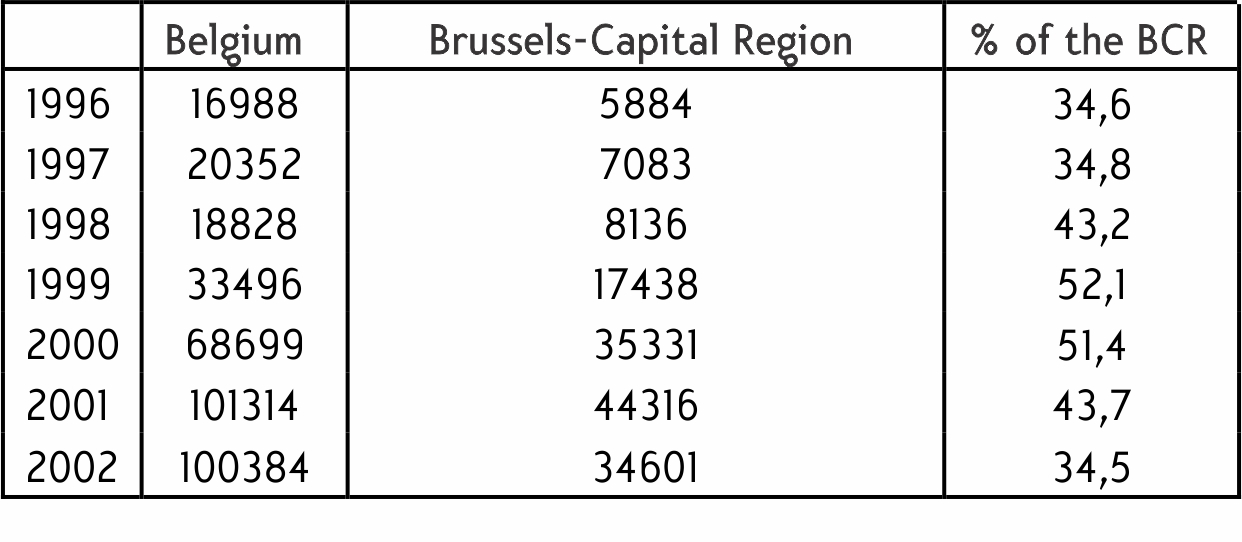 Pol Zimmer, "Les évolutions démographiques et socio-économiques de la Région de Bruxelles-Capitale depuis 1990", in Courrier hebdomadaire du CRISP, 2007/3 n° 1948-1949, p. 17. Available online.
Foreigners in Brussels today
The population of the Brussels-Capital Region is therefore very diverse. In 2018, 180 different nationalities were living side by side in that region. You can see who are the main nationalities in the following graph:
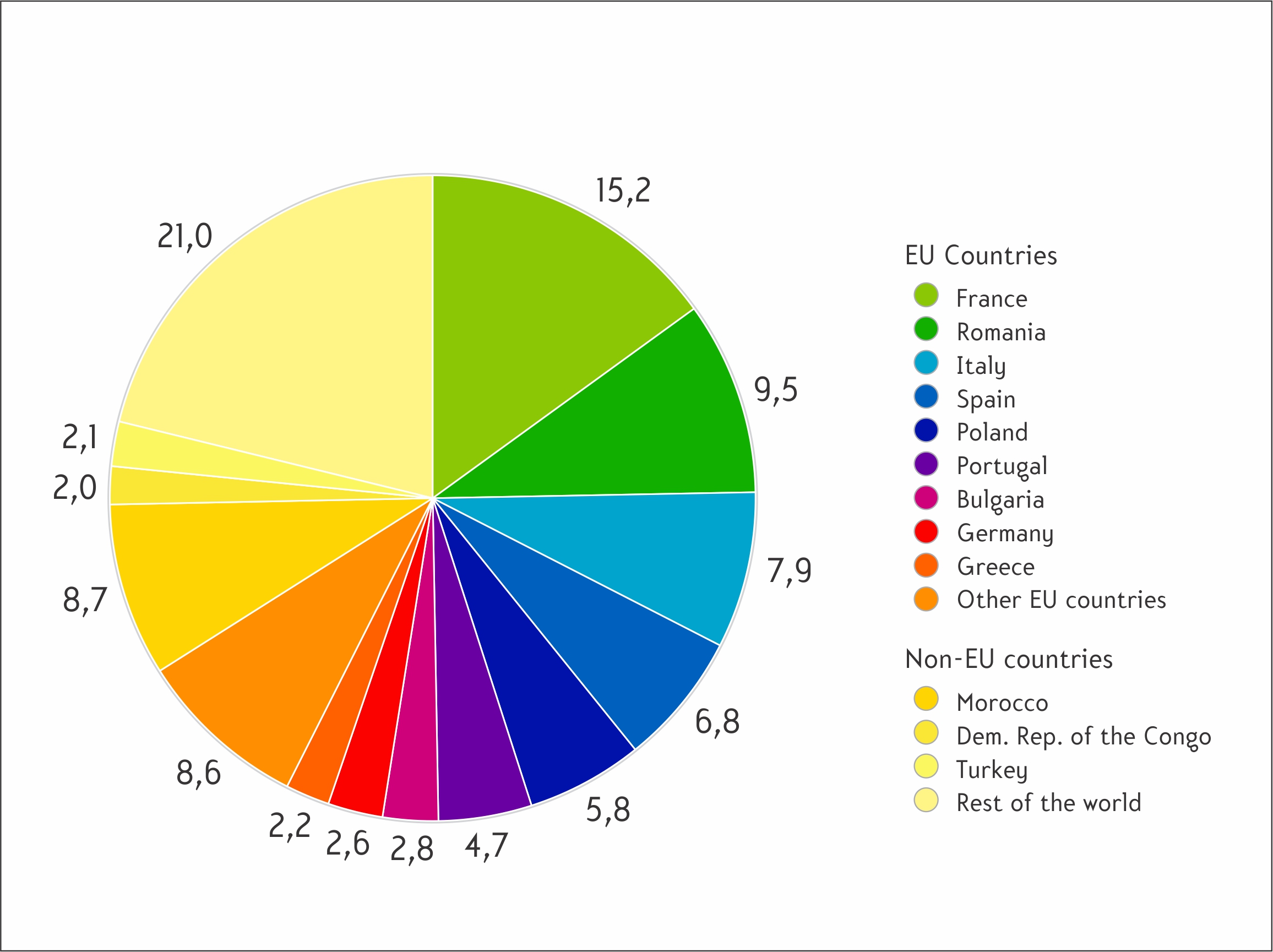 The main foreign nationalities present in the Brussels-Capital Region in 2018. Source: Mini-Bru de l’IBSA de 2019, available online. Remember that we are talking about current nationalities here.
As you can see, in 2018 the French were the first foreign community from the EU present in Brussels (if we take the current nationality of the inhabitants as a criterion). Between 2000 and 2018, their number almost doubled, from 35,000 to 65,000, i.e. 22% of the increase in the number of Europeans. People of Romanian and Italian nationalities occupy respectively the second and third place in the European communities most represented in the Brussels population. Those of Moroccan nationality form the largest non-European community in the Region.
All these data show you just how really diverse the population of Brussels is! Regardless of the criteria chosen, a large majority of Brussels residents have roots abroad.
Do you have a suggestion, comment or remark about this activity? Click here!