Activity 4: Migration and territorial and social dynamics in Brussels

Brussels, the second most cosmopolitan city in the world?
Activity 4: Migration and territorial and social dynamics in Brussels
As you saw, over the course of its history, Brussels has experienced a double movement of population, with foreigners coming to live and work there (immigration) on the one hand, and Brussels residents leaving the centre of the city to settle in its periphery (peri-urbanisation) on the other hand. Let us take a closer look at the places of residence that are chosen in each of these situations.
Where do immigrants settle?
Migrants with few qualifications who came to work in Brussels in the 1960s and 1970s mostly settled in the west of the city, in the working-class districts where industrial activities and cheap housing were located. These populations and their descendants tended to stay in the same neighbourhoods (particularly for reasons related to the cost of housing), gradually transforming their physiognomy and the systems of social relations between inhabitants.
The statistics for 2019 show that the majority of Brussels residents of North African origin live in the neighbourhoods that make up the 'Brussels poor crescent', an almost seamless area that forms an arc to the west of the city centre. People of Turkish origin live mainly in two municipalities located north-east of the city centre: Saint-Josse/Sint-Joost and Schaerbeek/Schaarbeek.
South American and sub-Saharan African immigration in the 1990s also went to the poor crescent neighbourhoods. The South Americans are mainly to be found in the municipalities of Anderlecht and Saint-Gilles/Sint-Gillis, while the population of sub-Saharan African origin has chosen instead to settle in the municipalities north and west of the city centre (in the municipalities of Brussels, Schaerbeek/Schaarbeek, Molenbeek and Anderlecht) as well as in the south-east of the centre, mainly in Ixelles/Elsene, where Matongé, an important African commercial and business district, is located.
The majority of foreign executives and (senior) civil servants have settled in the more posh neighbourhoods in the east and south of the Region, or even in the periphery, where their presence has had a direct impact on property prices.
As you can see, the spatial distribution of the population of foreign origin in Brussels is far from uniform. Below are several maps showing the current location of populations of different origins in Brussels. Based on what you have just learned, associate each map with the origin of the immigrants shown on it.
Peri-urbanisation: an internal migration
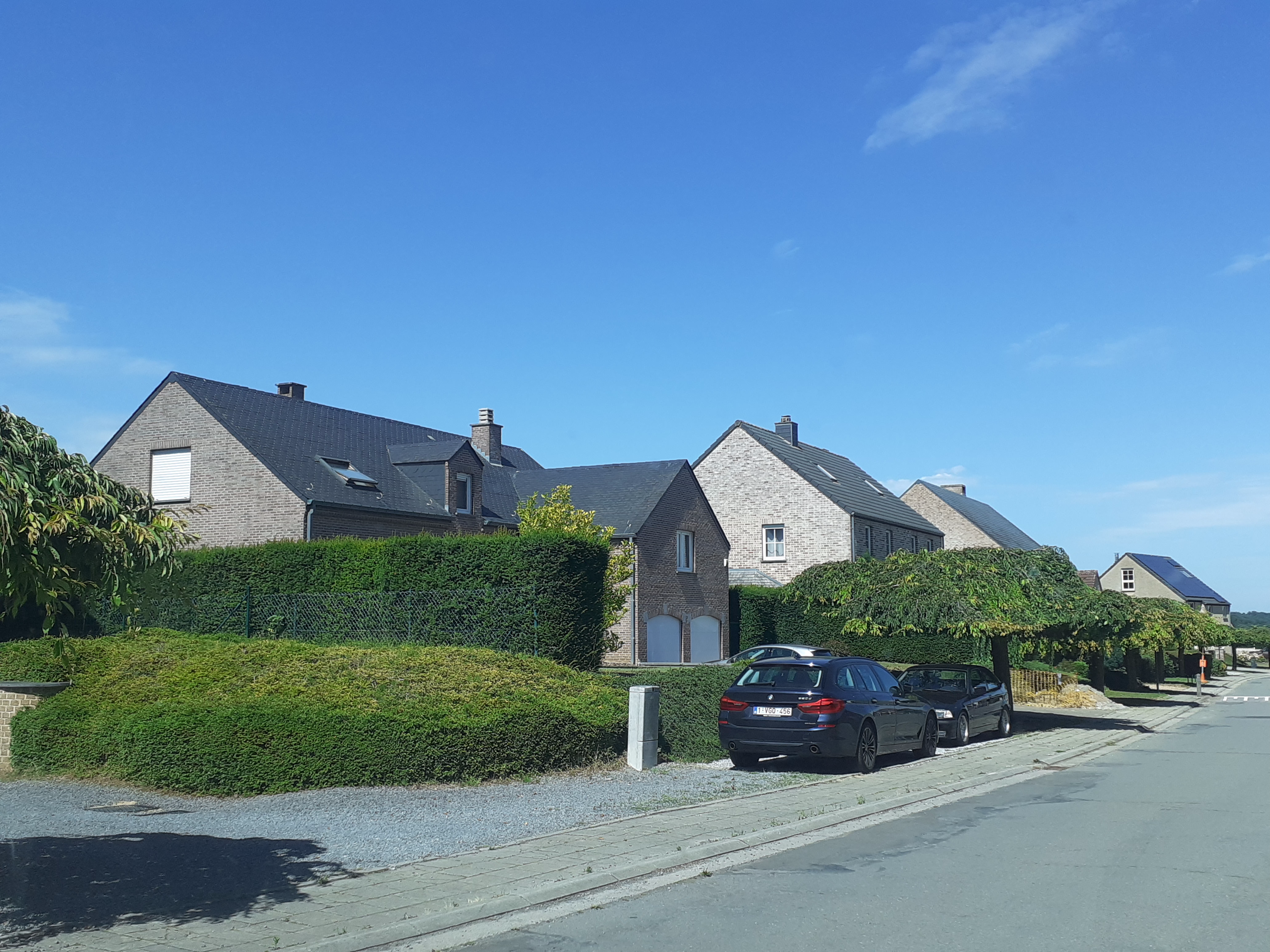
Example of a villa in a residential suburb, here in Wavre, 25 minutes by car from Brussels. © Iadine Degryse
Population movements are not only international. Brussels is also marked by significant internal migration within Belgium, which reinforces social dualisation in the metropolitan area.
As you have already observed, this phenomenon is very clearly marked by peri-urbanisation, the departure of the urban middle classes to certain well-off municipalities on the periphery or more distant suburbs (even if there is also a renewed interest in the centre from young adults). Peri-urbanisation has been ongoing since the 1960s and can be explained by a range of factors, such as high property prices in the city centre, the desire for a garden, support from public authorities for access to home ownership or home-work mobility.
In addition, a negative perception of the city also led many people to settle outside the city to enjoy a large house, the model of the four-faced villa being overvalued in the Belgian architectural imagination. Between 1997 and 2016, an average of 33,297 inhabitants left the Brussels-Capital Region each year to settle in the Walloon Region (14,597 inhabitants, mainly in the Walloon Brabant and the Hainaut) and the Flemish Region (18,700, mainly in the Flemish Brabant, in the immediate vicinity of Brussels, but also on the coast which attracts many pensioners).
The expansion of peri-urbanisation has multiple consequences. It contributes to reducing the proportion of the population of Belgian origin in the Brussels-Capital Region, but also generates an increase in the number of commuters, since a large proportion of these "internal migrants" continue to work in the Region. When they travel to Brussels by car, they contribute to making it one of the most congested cities in the world (see section 4). Moreover, in a system where taxes are largely paid at the place of residence and then redistributed according to complex mechanisms between Regions and Communities, peri-urbanisation does not facilitate the financial balance of the central part of the metropolitan area.
Migration from the Brussels-Capital Region to the Flemish Region (2012-2016)
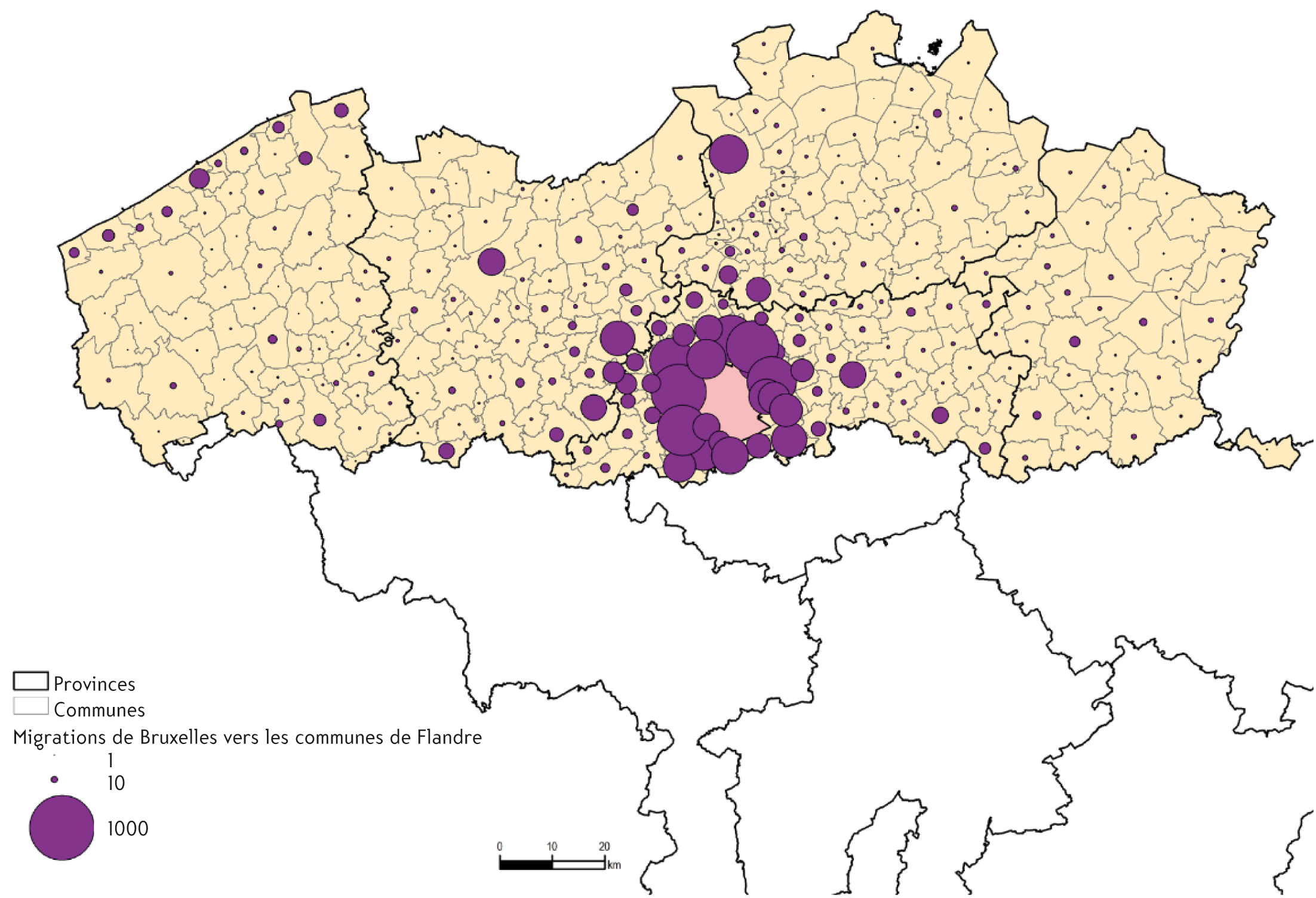
Source: J. CHARLIER, M. DEBUISSON, J.P. HERMIA, E. PELFRENE (2019). Interregional migration in Belgium. Research report from a special edition of IBSA, IWEPS, Statistiek Vlaanderen, available online.
Migration from the Brussels-Capital Region to the Walloon Region (2012-2016)
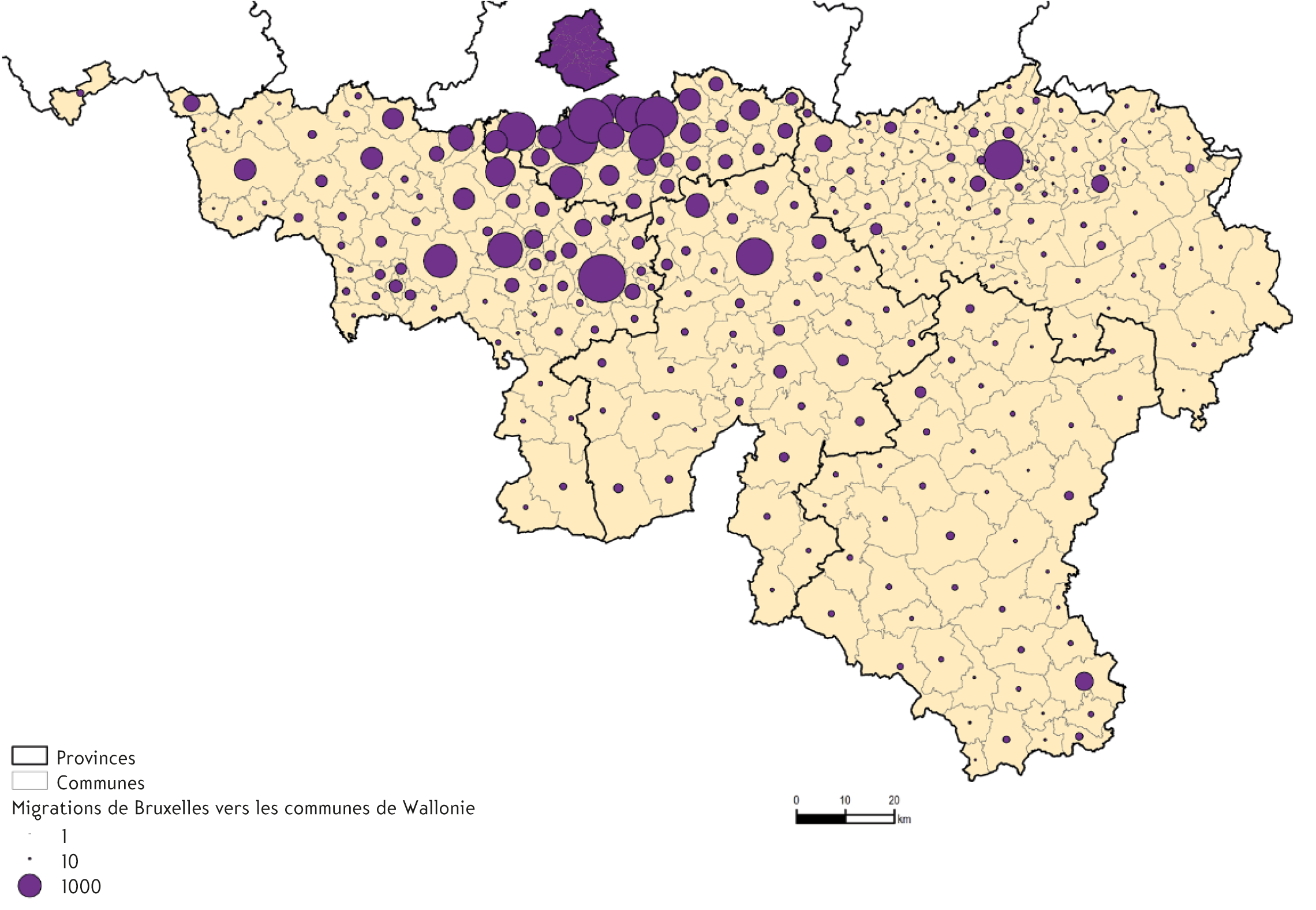
Source : J. CHARLIER, M. DEBUISSON, J.P. HERMIA, E. PELFRENE (2019). Interregional migration in Belgium. Research report from a special edition of IBSA, IWEPS, Statistiek Vlaanderen, available online.
There are also immigration flows to Brussels from the rest of Belgium. They are mainly young people who come to live in the capital. The wide range of education offered in Brussels plays a decisive role here: many students choose to live in the capital at the end of their studies.
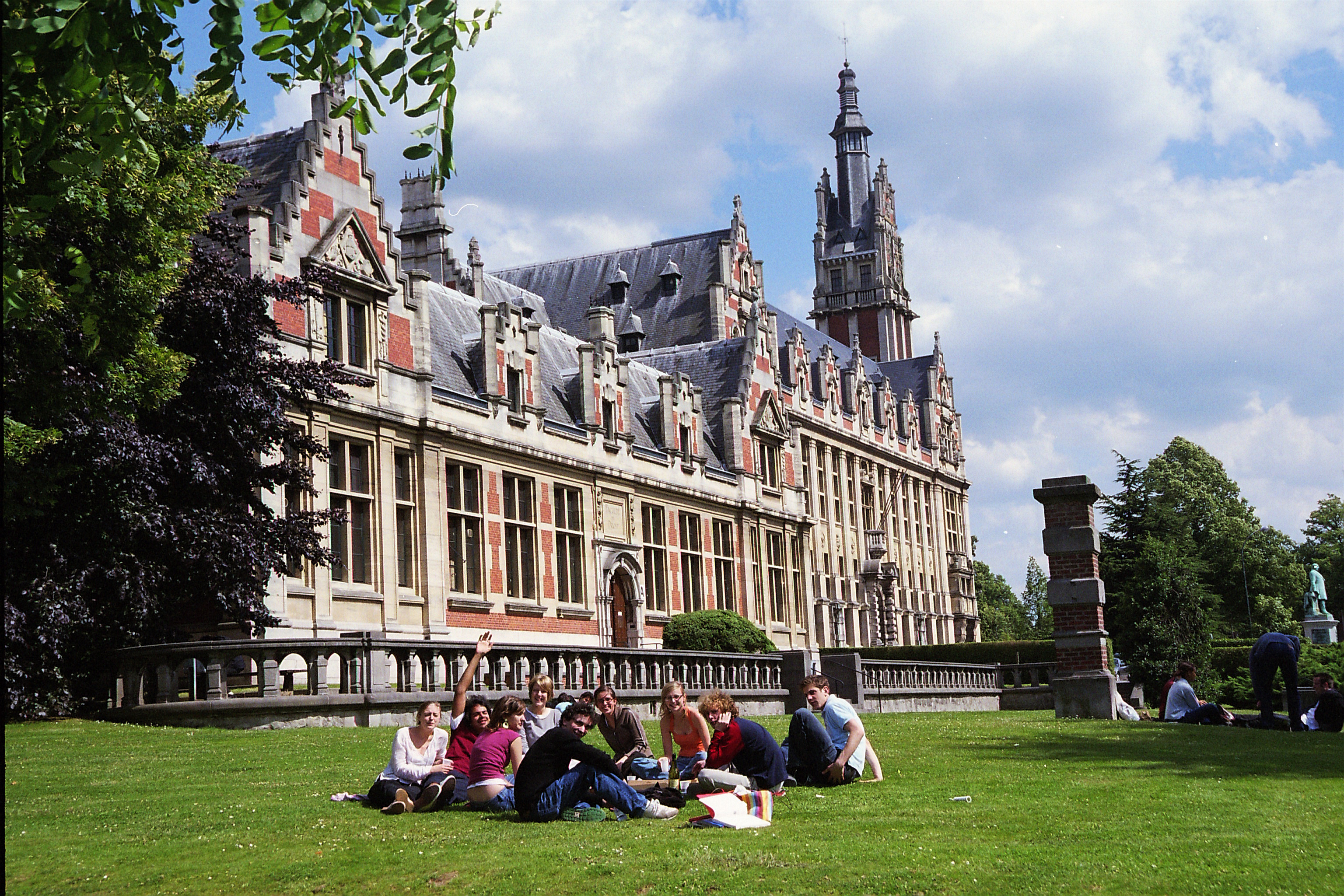
The Université libre de Bruxelles attracts a large number of Belgian and foreign students to the capital. Pictured here are the ULB buildings built in the early 1920s on the Solbosch campus. © Meusulb2013, CC BY-SA 3.0
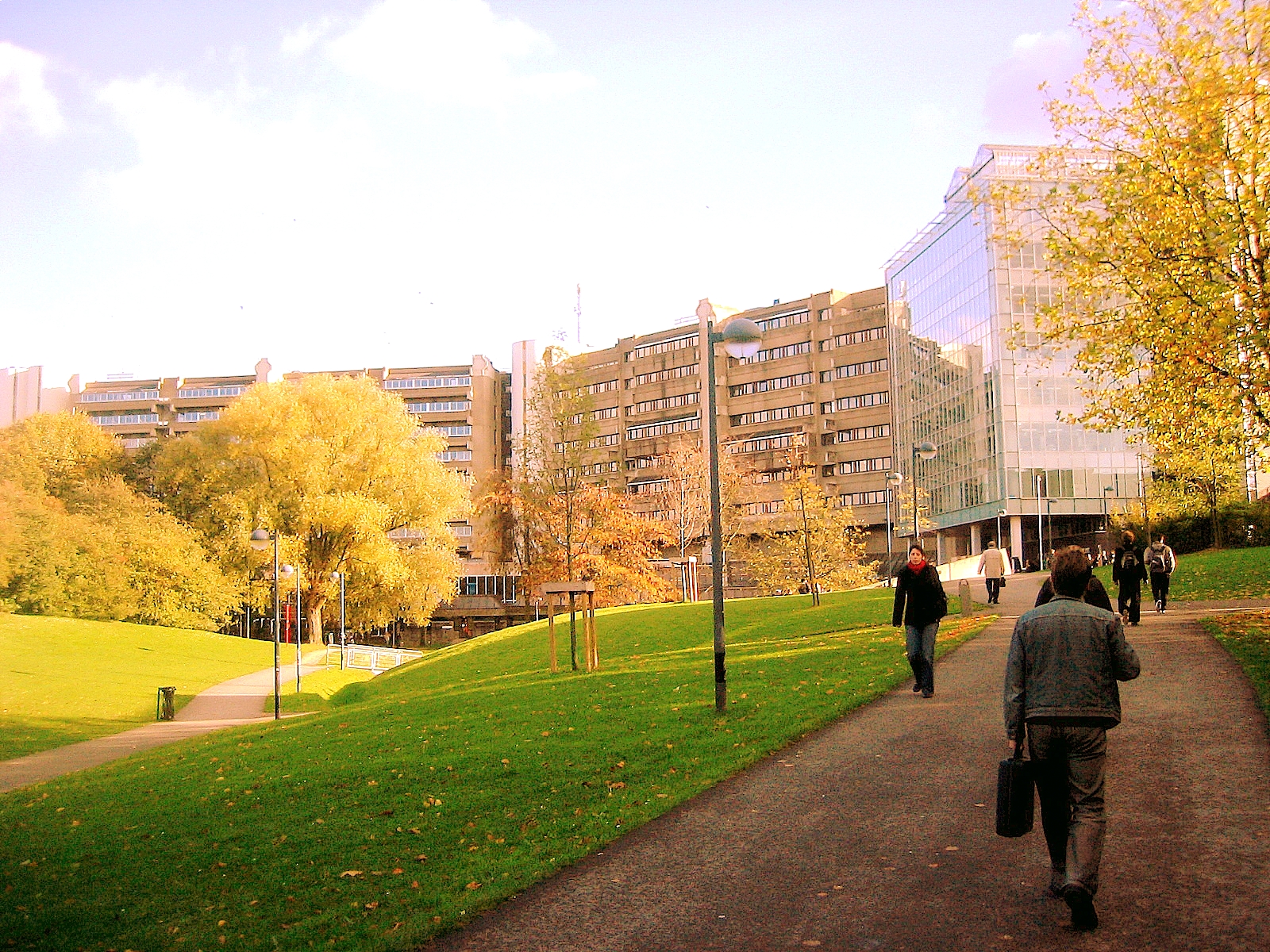
The Vrije Universiteit Brussel, a spin-off of the ULB, also attracts many students to the capital. View of the VUB campus in Etterbeek, officially called the "Brussels Humanities, Sciences & Engineering Campus" and built from the 1970s onwards. © I, Big Apple, CC BY-SA 3.0
Young professionals, especially when they have no children, make up a large part of the (Belgian) population that comes to live in the capital, close to their place of work or study. Moreover, international immigration is also very young. As a result of these various factors, young adults are dramatically over-represented in the structure of the capital compared to the rest of the country.
Today, the Brussels-Capital Region is the only Belgian Region that can boast about having a relatively younger population, whereas in 1991 it was still the "oldest" Region in the country. However, there are still huge differences between the municipalities and districts of the Region. Paradoxically, the Region now has the "youngest" municipality in the country (Saint-Josse/Sint-Joost) and one of the "oldest" (Watermael-Boitsfort/Watermaal-Bosvoorde).
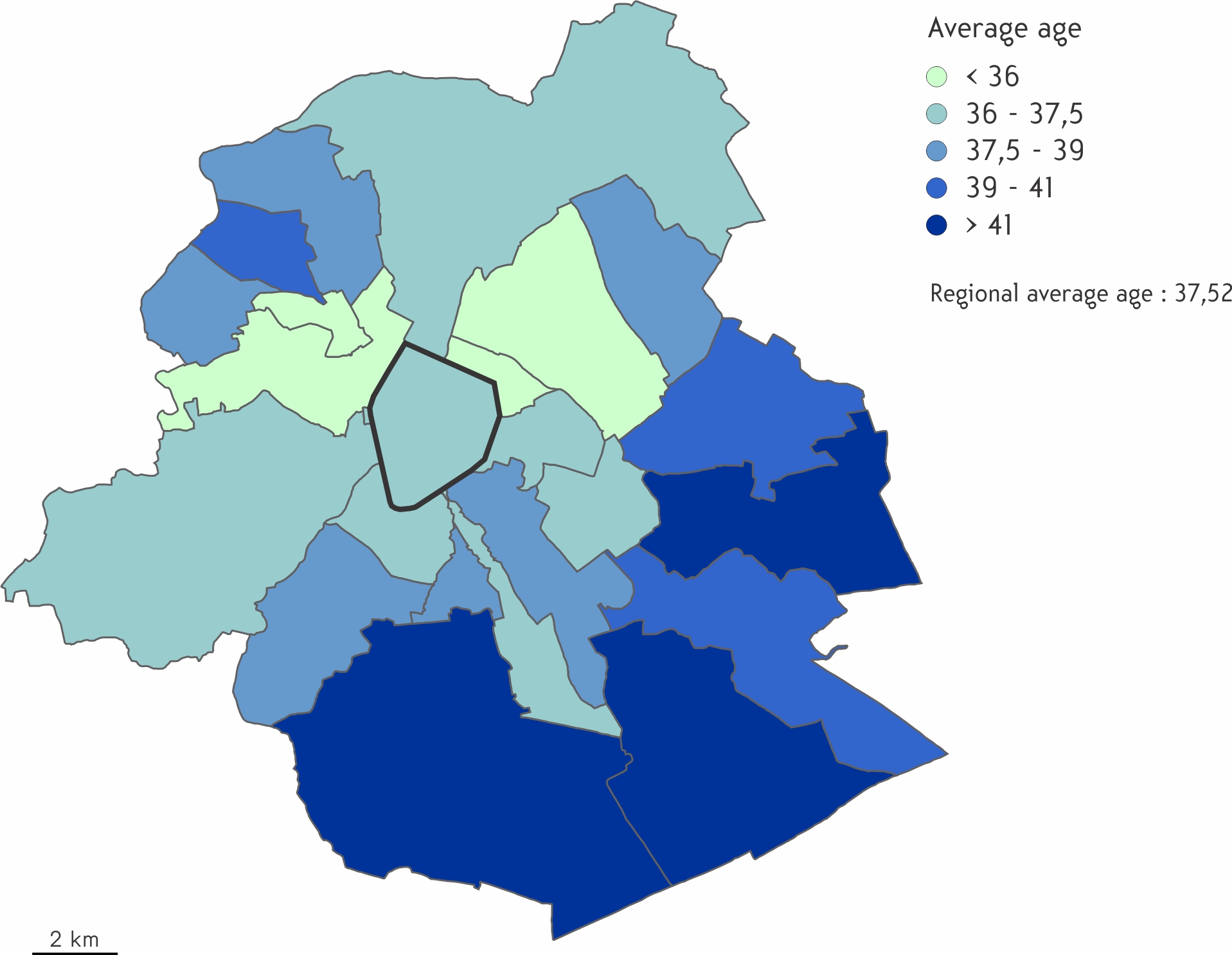 Average age in Brussels in 2019 by municipality.
© Monitoring des quartiers
Based on what you have just learned, read these questions carefully and choose the right answer.
Question 1
Question 2
Question 3
Question 4
Question 5
Do you have a suggestion, comment or remark about this activity? Click here!