Activity 7: Is Brussels monocultural, bicultural or multicultural?

Brussels, the second most cosmopolitan city in the world?
Activity 7: Is Brussels monocultural, bicultural or multicultural?
The various migratory waves that Brussels has experienced, as well as its status as the headquarters of many international institutions, have helped shape its multicultural image, which today is one of its main characteristics. We can in fact distinguish two major cultural dynamics specific to Brussels: a multiculturalism that reflects the different immigration waves and a Francophone/Flemish biculturalism, due to the presence of the two major language groups in the capital.
An example of multiculturalism: Matongé
In Ixelles/Elsene, the Matongé district (named after a district of Kinshasa in the Congo) reflects Belgium's colonial past in the Congo, Rwanda and Burundi. As early as the 1880s, colonial institutions established their headquarters there, including the archives of the Congo. Regarded as the central African district of Brussels, bars and clubs such as the Mambo opened there in the 1950s, attracting not only colonial officials who frequented the district, but also Congolese people who had been allowed to study in Belgium since 1952 and who stayed at the Maison Africaine. After Congo's independence in 1960, many businesses emerged and wealthy Congolese people bought luxurious and fashionable products during their stay in Brussels.
The district also became an important centre for Central African music, which continues to flourish to this day. Take a look, for example, at this clip directed by "Bruxelles ma belle" where Mali star Boubakar Traoré plays "Mondeou" in a hairdressing salon in the Matongé gallery.
The economic and political instability of the 1980s in the Congo, Rwanda and Burundi led to a decline in the number of wealthy visitors. Several luxury shops were replaced by more modest shops, such as travel agencies or grocery shops selling African products. Merchants from other countries came to settle in the neighbourhood: Haitians, Guineans, Cape Verdeans... then in the 1990s, Pakistanis, Lebanese, Rwandans, Senegalese, Cameroonians and South Americans. Today, more than forty different nationalities can be found there.
Using the map below, discover some of the emblematic places of the Matongé district:
The decolonisation of the public space
On 30 June 2018, the Brussels City Council inaugurated the Patrice Lumumba Square, located at the entrance of the Matongé district. As Prime Minister of Congo in 1960, Patrice Lumumba was one of the main architects of the country's independence before being assassinated on 17 January 1961, an assassination for which it was revealed, following a parliamentary enquiry, that Belgium bore its share of responsibility. Patrice Lumumba is today considered a national hero in the Democratic Republic of Congo.
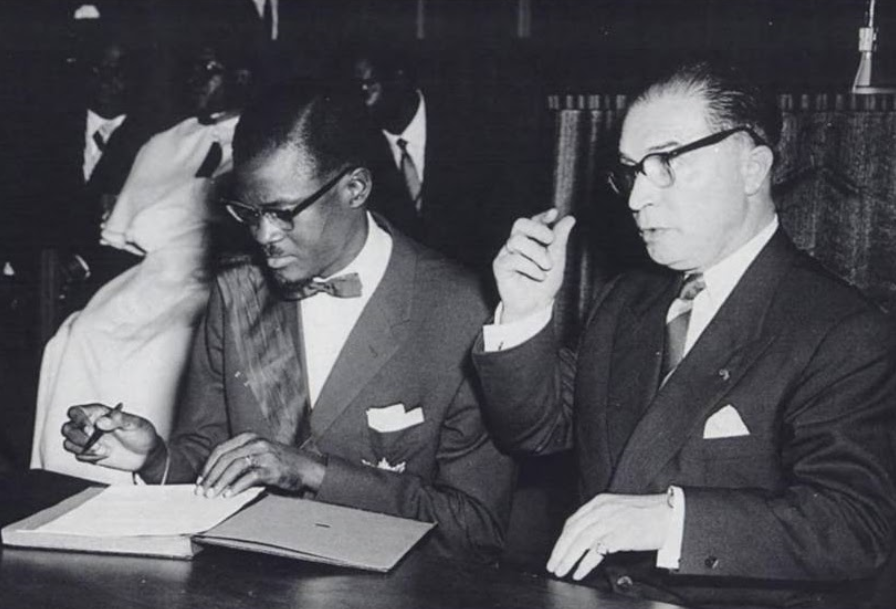
On 30 June 1960, Patrice Lumumba signed the Act of Independence of the Congo. Next to him, the Belgian Prime Minister of the time, Gaston Eyskens. © Congopresse photo (1960): Léopoldville, Public domain.
A brief history of Belgian colonisation in the Congo
The establishment of the Belgians in the centre of the African continent was at first the personal work of King Leopold II (1835-1909). After various unsuccessful attempts, particularly in China, the second Belgian sovereign turned his attention to Central Africa. At the Berlin Conference (1885), the European powers took note of the existence of an "independent state of the Congo", personally belonging to the Belgian sovereign but in which the latter had never set foot. It was indeed a personal property in the sense that the Belgian political class was hardly interested in a colonial project.
From 1894-95, Leopold II made significant profits from his colony (notably from the exploitation of non-ferrous metals, diamonds, ivory and mostly rubber) but instead of investing them in local Congolese infrastructure, he used them to embellish Belgium, and Brussels in particular, by building sumptuous buildings.
For the Congolese people, colonisation will be synonymous with extreme exploitation. The scale of the exactions against the local population will eventually even move the international community. Under pressure from England in particular, Leopold II was finally forced to cede the Congo to Belgium in 1908. The Congo then became a Belgian colony that did not gain independence until 1960.
In Brussels, the immediate traces of Leopold II's colonial policy are very present in the urban landscape. The man who was once nicknamed the "builder king" used the profits he gained from exploiting the Congo to undertake a policy of large-scale works in the capital such as the Cinquantenaire arcade, the Laeken Castle, the Palace of Justice, the Tervueren Palace, etc. Many streets, squares and statues are still a reminder of this dark period in history.
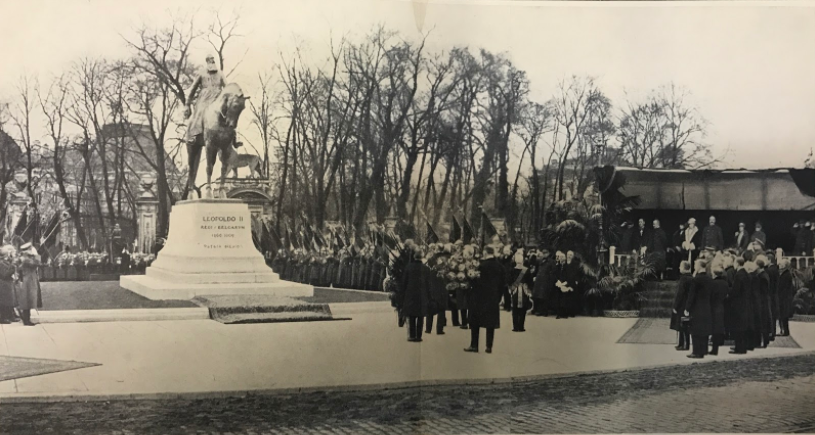
The inauguration of the equestrian statue of Leopold II in the centre of Brussels in 1926. © Patriote Illustré — X, Léopold II. Les monuments de Bruxelles et de Léopoldville, Bruxelles, Vromant & C°, s.d., p.7 à 36., CC BY-SA 4.0.
In recent years, the traces of the Belgian colonial past, displayed in the urban landscape without the slightest contextualization, have been the subject of multiple denunciations but also of various acts of vandalism carried out by activists who denounce the absence of policies to decolonize the public space. You will find below some pictures illustrating the above. Move the cursor to the right to discover them.
There are many debates between those who advocate to maintain the controversial statues and street names on condition that they are contextualised (by means of an explanatory plaque for example) and those who demand to rename these spaces and remove some statues and erect others. In order to better understand the legacy left by colonisation in the Brussels area, check on the map below the names of the streets referring to that period. You will notice how much these toponyms reflect the point of view of the coloniser, and not that of the colonised:

In Brussels, as in the rest of Belgium and more generally throughout the world, debates about the place of the colonial past in the urban space are regularly getting the headlines.
The contribution of international migration to the diversification of Brussels' cultures
As you have just seen, colonisation has left a strong imprint on the territory of the Brussels Region, and so did international migration, which has left its mark on its landscape and culture.
In Brussels, languages and cultures mix and mingle, forming a very varied artistic and cultural scene. An example of Brussels' cultural richness is the famous "Zinneke Parade", a kind of carnival organised every two years. As a socio-cultural project launched in 2000, the Zinneke Parade aims to highlight the diversity of the city and its inclusive character, particularly by focusing on the inclusion of inhabitants from disadvantaged neighbourhoods and people with an immigrant background. Conceived as a multilingual and intercultural project, the event has made its mark by promoting social cohesion, building bridges among the Brussels population and facilitating the integration of its inhabitants.
The term 'zinneke' in Brusseleir (an old dialect spoken in Brussels) means 'mongrel dog' and also refers to an inhabitant with a diverse cultural background. By choosing that name, the organisers wished to highlight the cultural mix of people from very different backgrounds in Brussels.
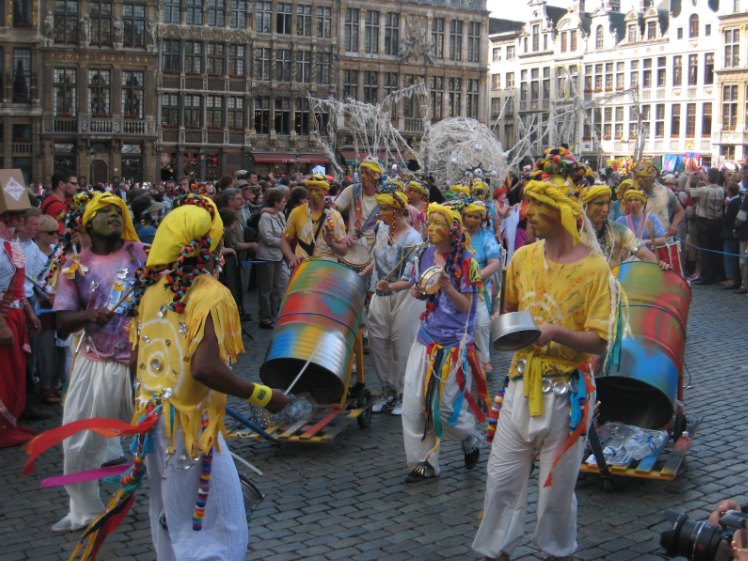
The Zinneke Parade in 2010 on the Grand-Place of Brussels. © David Edgar, CC BY-SA 3.0
In line with the administrative and institutional overlapping of Brussels, the Zinneke parade is organised by two NPOs (non-profit organisations). One is French-speaking and the other one Dutch-speaking. They share the same social goal, the same general assembly and the same members on the Board of Directors. There is only one difference: the president of the French-speaking NPO is the vice-president of the Dutch-speaking board, and vice versa. The ingenuity of the organisers therefore enables them to apply for subsidies from both the French and Flemish Communities to organise the same event.
Watch the video below and immerse yourself in the atmosphere of the Zinneke Parade to learn more about it:
Biculturalism: French and Dutch speakers in Brussels
In addition to the 'exogenous' multiculturalism of Brussels (reflecting the different waves of immigration that the city has experienced), there is also an 'endogenous biculturalism' deriving from the presence of two major language groups in the capital: French-speakers and Dutch-speakers. As you already know, Brussels is officially bilingual (Dutch and French), even though a wide range of languages are spoken there.
Around the time of Belgium's independence, the majority of the population of Brussels spoke either a Flemish dialect or Dutch (60.3% according to the 1846 language census). In the following decades, the growth of the city was accompanied by a gradual francisation of its population. The French language had many advantages. It was not only the language of the elites and international diplomacy, but also, in the new state, of the central administration and the national authorities in Brussels. French, therefore, benefited from a strong socio-cultural prestige and facilitated access to a labour market where its knowledge was necessary for jobs with a higher socio-economic status. Finally, it is worth remembering that French was, for a long time, the main if not the only language of higher education.
The graph below illustrates the evolution of language practice in Brussels based on census data which used to include a language component until 1947. This component was subsequently abolished, which means that today it is no longer possible to obtain information directly from the accounts of the inhabitants of the Region. It should also be noted, however, that the linguistic data from the censuses should be treated with great caution as they have been the subject of strong methodological disputes.
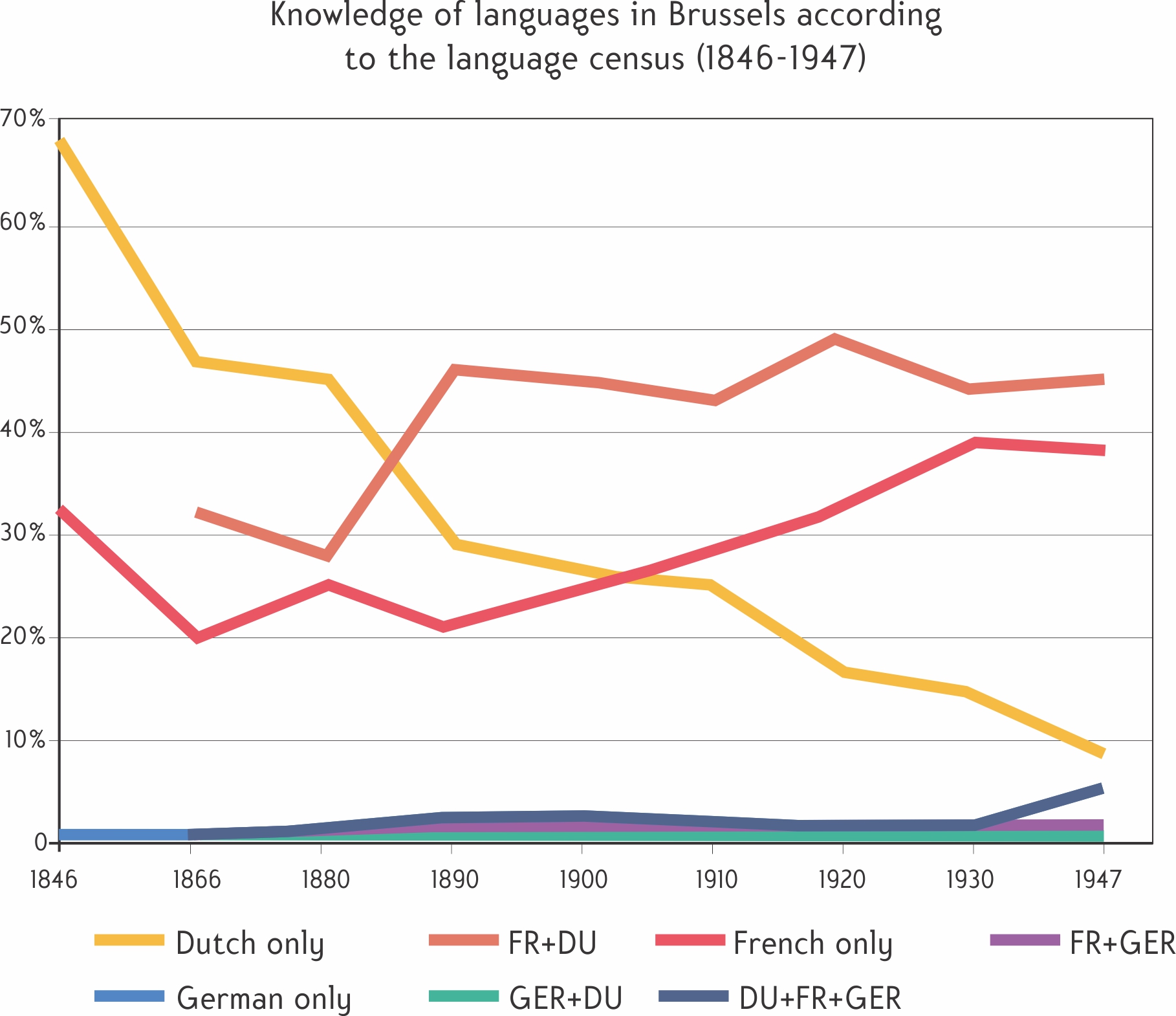 Source: Calculations of BRIO (VUB) based on the 'Officiële uitslagen van de talentellingen', Bibliotheek Queteletfonds'
While census data should therefore be treated with caution, they however show a general trend since 1846: the dramatic decrease in the proportion of Brussels residents who only speak Dutch and the increase of those who only speak French or consider themselves to be bilingual (French/Dutch). Indeed, in 1947 the census indicated that, for the future territory of the 19 municipalities of Brussels, 45.1% of the population was bilingual (French- and Dutch-speaking), 38% was only French-speaking and 9.4% was only Dutch-speaking.
In 2018, it was estimated that 87.1% of Brussels residents speak French and 16.3% speak Dutch.
Today, the challenge of bilingualism is not the same for Dutch and French speakers. In their study on language quarrels in Belgium published in 2011, Els Witte and Harry Van Velthoven define French in Brussels as the "dominant language", i.e. the one spoken predominantly in the city and which gives access to a higher social position and better social recognition. In contrast, Dutch in Brussels is the 'inferior' language because it is less commonly spoken in the city. Therefore, even though in most Brussels schools, learning the second national language is compulsory, French speakers in Brussels do not really see the point of mastering Dutch. On the contrary, Dutch-speakers in Brussels have long perceived mastery of French as a useful springboard for their professional and social careers. Statistics show that they make more of an effort to acquire a good command of the second national language.
If historically, mastery of the French language may have been a form of social prestige, the trend is now reversing in Brussels: for many French-speakers, mastering Dutch is today seen as a new form of social prestige. For example, education in Dutch in Brussels is sometimes perceived as being of better quality than education in French, which, as a result, leads some French-speakers to send their children to school in Dutch instead of French.
The two languages therefore have a different and evolving social status. In this context, culture is a major strategic challenge, because it is notably through culture (and teaching) that a language can be better diffused and that its visibility and survival can be ensured.
The institutions of the French and Flemish Communities each promote the creation and development of many local services in their own language, such as libraries, cultural centres or theatres. This is part of the French- and Dutch-speaking cultural policies which seek to strengthen their anchoring in certain urban spaces in Brussels (you will learn more about this in section 6), although there are still some important bilingual cultural institutions in the capital (i.e. Bozar, the Royal Museums of Art and History, etc.).
The use of languages in Brussels is therefore closely linked to how the city is organised and to the balance of power between the two linguistic communities.
Do you have a suggestion, comment or remark about this activity? Click here!